Teachers are among the most important members of society, shaping children’s lives and mentoring the leaders of tomorrow. They educate, encourage, discipline, and often go far beyond classroom duties to support their students’ wellbeing.
Despite their immense contributions, teachers are frequently among the least compensated professionals. Long hours, emotional investment, and extra responsibilities often fall outside their official job descriptions — acts of service that rarely make headlines.
Every so often, a moment arises that reminds the public just how profoundly teachers can influence children’s lives in simple, human ways. One such moment captured widespread attention in early 2019. It began with a short video recorded at W.G. Nunn Elementary School in Valdosta, Georgia.
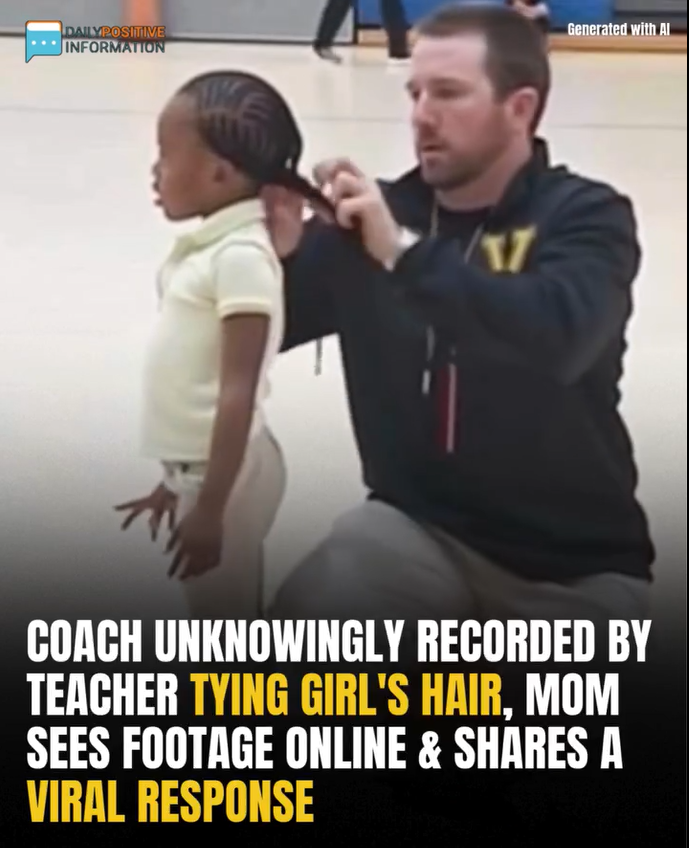
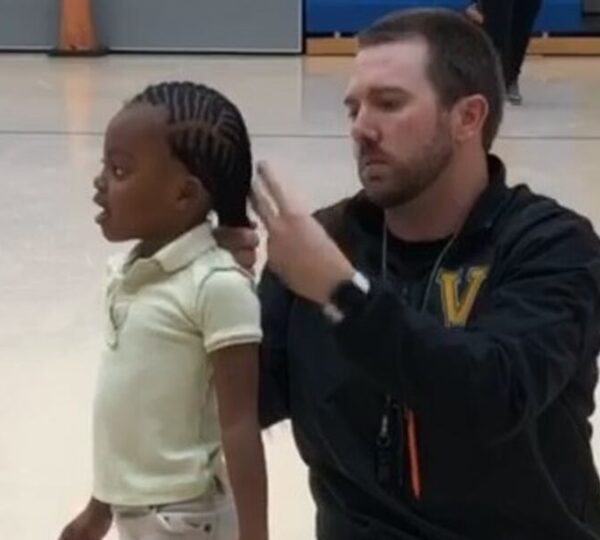
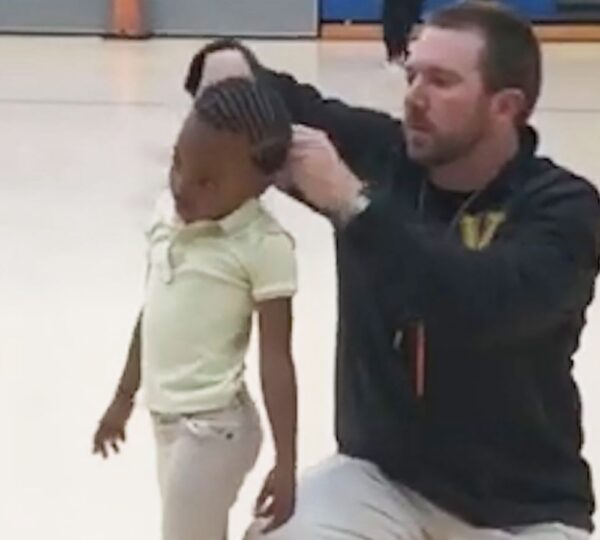
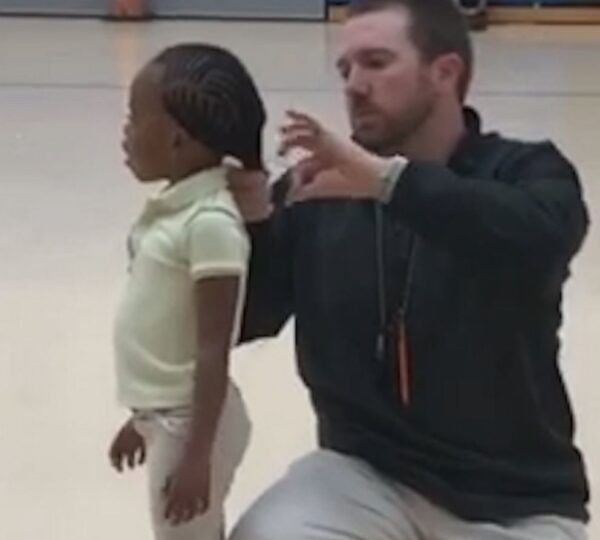
The video showed Jonathan Oliver, a physical education teacher at the school, pausing during a kindergarten basketball game to help a young student by fixing her hair into a ponytail.
Oliver was coaching children during a gym activity when kindergarten student Kristen Paulk approached him with a small request: she needed help tying her hair out of her eyes so she could continue playing comfortably.

Without hesitation, Oliver knelt down on the gym floor — balancing on a basketball to be at Kristen’s level — and carefully secured her hair into a neat ponytail, doing precisely what she asked.
The act was brief and seemingly ordinary, but it was captured on video by Kandice Anderson, an assistant kindergarten teacher at the school. She later shared the clip on Facebook with the caption, “When your job goes beyond teaching… #CoachO #LoveIt.”
The video quickly went viral, racking up more than three million views on social media and attracting attention from major news outlets nationwide.
Many viewers were touched by the gentle moment, seeing in it a reminder that education is not just about academics, but about caring for children as complete human beings. The clip spread across Facebook, YouTube, and national morning shows.
When approached by Good Morning America, Oliver — then 34 years old — was genuinely surprised by the attention his small gesture received. He said he never intended to go viral and didn’t even realize he was being recorded.
“It was shocking to me that it got that much attention because we all do it,” Oliver told the television program. For him, helping Kristen was simply part of his job as a teacher and coach — not a moment he expected the world to see.
Oliver emphasized that educators aim to build environments where students feel comfortable, safe, and cared for — much like being at home. He said teachers often perform small acts of kindness that go unnoticed precisely because the focus is usually on instruction.
“We want to make them feel like they’re at home and that they enjoy being here. We try to love on them as much as possible,” he explained. The video was just a simple ponytail to him, but to many viewers it symbolized compassion.
Oliver, a father of three, also shared that while he regularly styles his own daughter’s hair at home, his hairstyling skills are limited to basic styles like ponytails — and that’s exactly what Kristen asked for.
“It was a good thing she asked for a ponytail,” he joked with reporters. “Anything else, I’d say, ‘You better ask your mom.’” His light‑hearted comment reflected both his humility and his role as a caring mentor.
Kristen’s mother, Miyah Cleckley, told Good Morning America that the video warmed her heart. She said she always feels confident sending her daughter to school under Oliver’s care because he consistently treats his students with respect and kindness.
“I always know that Kristen is in very good hands with him,” Cleckley said, adding that the moment was especially meaningful because Oliver helps his own children with their hair at home. With five girls and one son, hairstyling is a daily family task.
Her comment also highlighted how educators often serve roles that extend beyond instruction. Teachers frequently act as supportive adults, mentors, and role models — connecting with students in ways that build trust and confidence.
The video struck a particularly emotional chord because it offered a positive story in a media landscape often dominated by negative headlines. People welcomed a reminder of everyday kindness, especially one rooted in the educational environment.
Social media users poured praise into the comments: many lauded Oliver for his patience, his humility, and his willingness to treat each child with dignity and care, regardless of how mundane the task might seem.
Some viewers saw the moment as emblematic of what teaching should look like — not merely transferring knowledge, but building relationships grounded in respect, comfort, and understanding.
The outpouring of positive attention also sparked discussions about the invisible labor teachers perform every day. Many educators mentioned that small gestures like Oliver’s happen behind the scenes constantly, yet rarely receive public recognition.
Conversations on parent groups, educator forums, and news comments turned toward the broader role of teachers: as nurturers, emotional supporters, and often the trusted adults students look to when they need help.
Critics of the viral nature of the clip occasionally noted that helping a child with hair might seem mundane, but supporters pointed out that it’s precisely the ordinary acts of kindness that make schools supportive and safe spaces.
For Oliver, the attention did not change how he approaches his work. He continued his daily teaching duties and coaching responsibilities with the same dedication and spirit that led him to help Kristen in the first place.
His reaction also highlighted an important truth: many teachers do not seek praise for their actions. They are driven by a commitment to students’ wellbeing and success, placing children’s comfort ahead of their own comfort or recognition.
School communities often emphasize relationship building as part of student development, and moments like Oliver’s exemplify how teachers invest emotionally in students’ lives beyond academic instruction.
Experts in education note that strong teacher‑student relationships can boost students’ confidence, improve engagement, and contribute to overall emotional development — outcomes far beyond the classroom curriculum.
In an era when teachers face budget constraints, large class sizes, and administrative pressures, stories like Oliver’s provide a refreshing reminder of what compassion in education can look like — quiet, simple, and deeply human.
Teachers like Oliver often form supportive environments where students feel heard, appreciated, and safe — essential foundations for both academic growth and emotional wellbeing.
The viral video also sparked appreciation from parents who recognize how hard teachers work each day. Many parents shared their own stories of educators who went above and beyond, creating a broader celebration of teaching as a deeply human profession.
Others in the education community pointed out that teachers frequently coach values like kindness, cooperation, and empathy — qualities that are not measured by standardized tests but are critical for lifelong success.
Oliver’s gesture serves as a small but powerful example of how teachers create connections with students, building trust that extends far beyond academics and becomes part of a child’s memory of school.
It also reminds the public that teaching is not merely a profession but a vocation — a calling to support, encourage, and care for the next generation through patience and compassion.
Even a brief moment of assistance, like fixing a ponytail during a game, becomes a symbol of dedication when it reflects larger values of care, respect, and joyful engagement with students.
For Kristen, that small ponytail likely made her feel comfortable and confident at that moment — and for many viewers, it served as a reminder of the positive impact one adult can have on a child’s day.
In the years since the viral surge, many continue to reference the video as an example of “teaching beyond the textbook,” honoring the countless small acts teachers perform daily to nurture their students.
Above all, Jonathan Oliver’s story highlights a universal truth about education: that warmth, attention, and kindness are as vital to learning as instruction itself — and that great teachers often show care in ways that cannot be measured with grades alone.
