
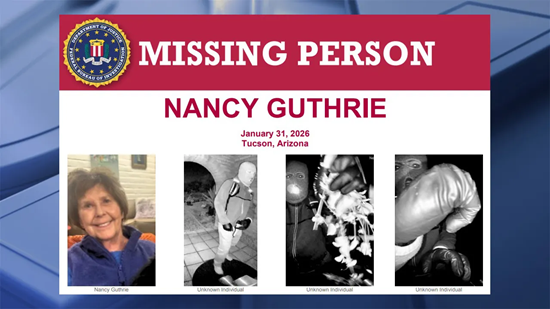
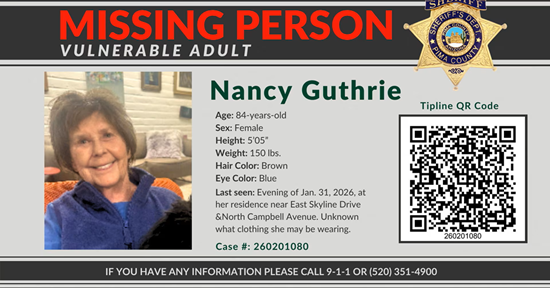
The disappearance of Nancy Guthrie, an 84-year-old woman reported missing from her home in the U.S. state of Arizona, continues to draw sustained public attention as investigators work methodically to determine what may have occurred during the early hours of her disappearance.
Authorities have confirmed that the case remains an active and ongoing investigation.
Law enforcement officials have repeatedly emphasized that many details have not yet been publicly verified, urging caution and discouraging speculation while evidence continues to be examined carefully.
According to publicly available information, Nancy Guthrie was reported missing on February 1 after family members were unable to locate her at her residence. Concern quickly escalated, prompting immediate contact with local law enforcement agencies for assistance.
Responding officers began their investigation by examining the home where she was last believed to be present. This initial stage is critical, as it allows investigators to document conditions at the scene and preserve any physical evidence.

Establishing a clear and accurate timeline is one of the most important early objectives in a missing-person case. Investigators rely on witness statements, environmental observations, and available data to reconstruct events leading up to the disappearance.
Authorities also conducted interviews with family members and nearby residents. These conversations can provide valuable insights into recent behavior, routines, or unusual circumstances that might help clarify what occurred prior to the reported disappearance.
Officials have stressed that investigations involving missing individuals often require time and patience. Evidence must be collected, processed, and verified using standardized procedures to ensure that conclusions are based on reliable and accurate information.
Early reports indicated that small traces of blood were discovered near the entrance of Guthrie’s residence. Authorities confirmed that the blood was identified as hers, but no conclusions have been publicly drawn about its significance.
In forensic science, the presence of biological material is considered an important but complex form of evidence. Specialists must carefully analyze such findings before determining whether they are directly related to a potential incident.
Forensic experts typically evaluate blood evidence by examining its distribution, direction, and pattern. These characteristics can sometimes provide insight into movement, possible injury, or environmental interactions at the scene.
However, interpreting blood evidence requires careful laboratory analysis and cannot be reliably assessed through observation alone. Many variables, including surface type and environmental conditions, can influence how such evidence appears.
Because of these complexities, investigators rarely release immediate conclusions about forensic findings. Instead, samples are processed through controlled laboratory procedures to ensure scientific accuracy and prevent misinterpretation.
In addition to forensic analysis, experts from fields such as sleep medicine have contributed general insights into how individuals may respond to sudden awakenings during nighttime hours, without making claims about this specific case.
One commonly discussed concept is sleep inertia, a temporary state of reduced alertness that occurs immediately after waking. During this period, cognitive performance and awareness may be briefly impaired.
Scientific research shows that the brain transitions gradually from sleep to full wakefulness. This process can vary depending on the stage of sleep from which a person awakens and individual physiological factors.

People experiencing sleep inertia may feel disoriented, have slower reaction times, and struggle with concentration. These effects are usually short-lived, but their intensity can differ from person to person.
Sleep is composed of multiple stages, including non-rapid eye movement (NREM) and rapid eye movement (REM) sleep. Each stage plays a role in physical restoration and cognitive function throughout the night.
Deep sleep, also known as slow-wave sleep, is particularly important for physical recovery. Awakening during this stage can result in more pronounced sleep inertia due to reduced brain activity at that time.
REM sleep, on the other hand, is associated with dreaming and increased brain activity. Waking during this phase may cause temporary confusion as the brain transitions from dream states to conscious awareness.
Researchers emphasize that these scientific explanations are general in nature. They are intended to help the public understand human physiology and should not be interpreted as explanations for specific events.
Aging can influence sleep patterns in several ways. Older adults may experience more frequent awakenings, lighter sleep cycles, and changes in circadian rhythms that affect when they feel alert or tired.
Despite these changes, older individuals can still experience sleep inertia, particularly if they awaken suddenly from deeper stages of sleep. The effects, however, vary depending on overall health and lifestyle factors.
Reports have also noted that Nancy Guthrie had a cardiac pacemaker, a medical device used to regulate heart rhythm. Pacemakers are widely used and allow many individuals to maintain normal daily activities.
Medical experts emphasize that having a pacemaker does not, by itself, indicate a specific health event occurred. Any potential medical factors would require professional evaluation and cannot be assumed without evidence.
In missing-person investigations, physical evidence is only one part of a broader process. Investigators also rely on witness accounts, digital data, and environmental observations to build a comprehensive understanding.
Digital evidence has become increasingly important in modern investigations. Surveillance footage, phone records, and electronic devices can provide valuable information about movements and communications before a disappearance.
Law enforcement agencies may collaborate with specialized units or external experts depending on the complexity of the case. This can include forensic laboratories, search teams, and analysts with technical expertise.
Search efforts in such cases are often carefully organized and may involve both professional responders and trained volunteers. These efforts focus on areas where the missing individual was last known to be present.
Community involvement can play a significant role in advancing investigations. Members of the public may provide tips, share information, or report observations that contribute to developing new leads.
Authorities typically encourage individuals to report any potentially relevant information through official channels. Even small details can sometimes prove important when combined with other evidence.
At the same time, officials caution against spreading unverified information. Speculation can complicate investigations and may cause unnecessary distress to families and communities affected by the situation.

Responsible reporting is essential during active investigations. Verified information helps maintain public trust and ensures that accurate details are communicated without interfering with ongoing efforts.
Families of missing individuals often face significant emotional challenges. Maintaining accuracy and sensitivity in public discussions is important to avoid adding further stress during an already difficult time.
As the investigation continues, authorities are likely to review additional evidence, conduct follow-up interviews, and analyze any new information that becomes available through official or community sources.
Updates in such cases are typically released only after verification. This approach helps ensure that any information shared with the public is reliable and does not compromise investigative procedures.
The disappearance of Nancy Guthrie highlights the complexity of missing-person cases, particularly those involving older adults, where multiple factors—including health, environment, and behavior—may intersect.
Experts across various disciplines continue to provide general educational insights to help the public better understand how investigations are conducted, without drawing conclusions about this specific case.
Ultimately, the goal of law enforcement remains clear: to gather accurate information, follow the evidence, and work toward understanding what happened, while maintaining professionalism and respect for those involved.
As efforts continue, authorities remain committed to uncovering reliable answers. The case stands as a reminder of the importance of careful investigation, community awareness, and patience in the search for truth.
