
In a candid and deeply personal interview, model, author and advocate Emma Heming Willis opened up about life since her husband’s diagnosis with frontotemporal dementia, offering an intimate look at love reshaped by illness.
Her conversation with journalist Diane Sawyer captured the emotional and physical realities faced by families affected by progressive neurological disease.
From the very first signs — subtle pauses in conversation, fleeting moments when the beloved actor seemed distant or disengaged — Emma described how life began to change long before a medical diagnosis was reached.
At first, those moments were easy to overlook. Family dinners once filled with laughter and Bruce’s signature warmth were instead punctuated by silence, pauses that left Emma wondering if something deeper was wrong.
“FTD doesn’t scream — it whispers,” she recalled those early weeks, describing how the changes unfolded so gently that even she struggled to know what to make of them.

Bruce’s initial diagnosis was aphasia, a language disorder that affects the ability to communicate — something that seemed, at first, less frightening than what ultimately emerged.
But as time passed and Bruce’s speech faltered and his vibrant personality dimmed in ways no medical explanation could fully explain, Emma knew the family faced something far more serious than hearing loss.
Frontotemporal dementia (FTD) was ultimately confirmed, a condition that attacks the brain’s frontal and temporal lobes, eroding language, memory and personality over time.
Upon hearing the diagnosis, Emma said their world did not simply change — it was shattered. The framework of their family life, their routines and expectations, all shifted in an instant.
Life with FTD is a slow transformation. One day after the next, the familiar man she married became someone different. It was a transition filled with both grief and love, Emma explained.
In the early days, Emma found herself trying to hold onto what had always been: the quick smile, the laughter, the shared jokes. But those moments became rarer, and the quiet stretches began to outnumber them.
“I remember thinking this couldn’t be the same person who joked with the world,” she said, voice wavering, “but then I learned that love doesn’t disappear when a mind changes.”

As Bruce’s primary caregiver, Emma soon discovered that the role demanded far more than love alone. It required resilience, patience, strength and a willingness to redefine what “normal” means for a marriage.
“It didn’t feel like a marriage anymore,” she said, her tone soft but steady. “It felt like a calling — a purpose that stretched deeper than anything I ever anticipated.”
The transition from spouse to caregiver was overwhelming at times, but Emma remained determined to care for Bruce with compassion and dignity, even as their lives transformed beyond recognition.
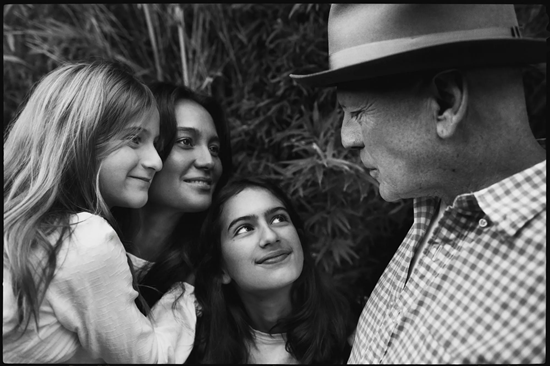
For the sake of their daughters — Mabel Ray (13) and Evelyn Penn (11) — Emma made the most difficult decision of her life: to place Bruce in a specialized care environment tailored to the needs of someone with dementia.
That decision was not made lightly. Emma emphasized that Bruce’s new residence is not a sterile institution, but a nurturing home filled with love, structure and familiarity — a place where compassion and connection still thrive.
“I want everyone to know it’s not a facility — it’s a sanctuary,” she explained, describing how friends, staff and family surround Bruce with laughter and warmth.

Despite the progress of his illness, Bruce remains physically strong, a phenomenon common in some forms of dementia where the body can remain robust even as the mind changes.
Emma cherishes the small, tender moments when Bruce still responds with recognition: a firm squeeze of her hand, a genuine smile when their daughters walk into a room, or a familiar gesture that speaks volumes without words.
These moments of connection, she said, are not driven by full consciousness of the past, but by deep, inherent bonds that remain intact despite the disease’s effects.
Her unwavering belief that Bruce still knows his family — even without fully understanding why — is both her comfort and her resolve, a testament to the enduring nature of love.
Out of this difficult journey, Emma found a new purpose: advocating for other families facing the often lonely and misunderstood path of caregiving.
She has chosen to speak publicly about her family’s experience, not just to raise awareness of FTD, but also to illuminate the emotional spectrum of caregiving — including exhaustion, isolation and the unexpected strength that emerges with each challenge.
Her message to caregivers is clear: no one should face this path in isolation. Love may change in appearance, but it does not diminish — and neither do the needs for support and community.

In her upcoming book, The Unexpected Journey: Finding Strength, Hope, and Yourself on the Caregiving Path, Emma offers an intimate reflection on her family’s experience, blending memoir with practical guidance for those walking similar roads.
The book is as much a tribute to Bruce’s life as it is a roadmap for caregivers willing to confront the fear, sorrow and self‑doubt that often accompany long‑term caregiving.
Emma does not shy away from the truth: caregiving is heartbreaking, exhausting, and often misunderstood by those who have never lived it. Yet she also highlights moments of joy, connection and purpose that bloom even in the hardest seasons.
Through her writing, she reaches out to families who feel unseen, offering them validation, solidarity and hope — a reminder that they are not alone in their struggles.
Her belief is that shared stories create shared strength, that visibility for caregivers can transform isolation into community, and that empathy can bridge divides between those suffering and those who wish to understand.
The ideas in her book are rooted in personal experience, but also grounded in connection — encouraging caregivers to seek support, to speak openly, and to allow themselves grace and vulnerability.
Emma’s advocacy has extended beyond her memoir. In March 2026 she launched the Emma & Bruce Willis Fund for Dementia Research and Caregiver Support, designed to raise awareness, promote scientific research and provide resources for families confronting FTD.
Her work with the Association for Frontotemporal Degeneration (AFTD) and other caregiver organizations has earned her recognition, including the Susan Newhouse & Si Newhouse Award of Hope, highlighting her influence in bringing attention to an often overlooked disease.
Emma has also been candid about the criticism she and her family have faced, especially regarding the choice to live separately from Bruce, explaining that only those who have walked this path can truly grasp its complexities.
“Caregivers are judged quickly and unfairly by those who haven’t lived this journey,” she said, emphasizing that love looks different in the context of dementia — and that decisions must reflect the unique needs of each family.
Her openness is not about inviting judgment — it is about connection, education and compassion for others who are also caring for a loved one whose personality gradually slips away.
Emma’s two young daughters also continue to navigate their father’s illness with honesty and resilience. She has told them the truth about Bruce’s disease, helping them understand and grieve while also celebrating moments of joy and connection.
“It’s hard,” she admits, “but kids are resilient, and they’ve learned that love can adapt just as we do.”
Through the grief, the transformation of their family life, and the daily challenges of caregiving, love remains central — not a static force but a living one that shifts shape, depth and expression over time.
Even as Bruce’s cognitive world grows smaller, Emma’s commitment to him — and to the caregiving community at large — continues to grow stronger, fueled by devotion, resilience and unwavering presence.
In her story of grace, courage and evolving love, Emma Heming Willis reminds us that even in silence, love still speaks — in gestures, in presence, and in the choice to stay.
