
For many, the thought of tackling math problems evokes memories of school days, complete with homework, exams, and endless worksheets.
While some thrived on logic and numbers, others eagerly awaited the creative subjects that allowed imagination to flourish.
Despite mixed feelings toward mathematics, brain teasers and numerical riddles retain a universal appeal. Even adults who rarely engage with equations often find themselves drawn to patterns, sequences, and puzzles that challenge reasoning skills.
Online platforms have become a hub for such mental exercises. Across social media and puzzle websites, millions of users compete, share solutions, and debate strategies for riddles that blend logic, arithmetic, and lateral thinking.
One math puzzle in particular has captured widespread attention. Though it appears simple at first glance, it quickly challenges intuition, prompting observers to question their approach and reconsider the conventional rules of addition.
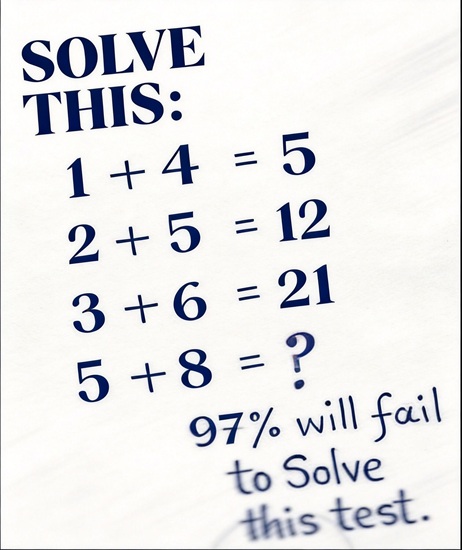
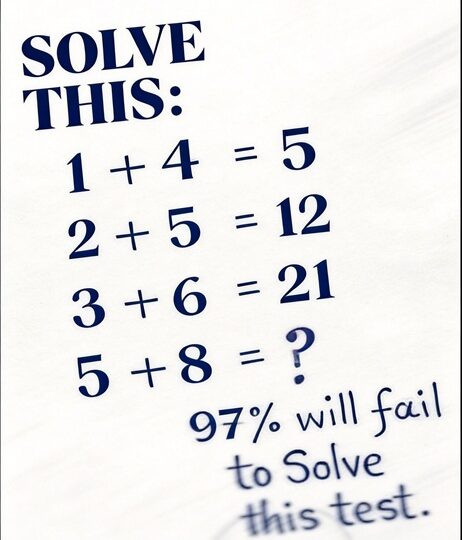
The puzzle presents a series of equations: 1 + 4 = 5, 2 + 5 = 12, 3 + 6 = 21, and finally 5 + 8 = ?. At first, the arithmetic appears straightforward, but patterns are not immediately obvious.
The first equation, 1 + 4 = 5, may seem normal. However, as the sequence continues, it becomes clear that standard addition rules do not fully explain the results, signaling that a hidden pattern or operation is at play.
The second equation, 2 + 5 = 12, immediately confounds expectations. If one applies basic arithmetic, the sum should be 7, not 12, suggesting the presence of either a cumulative pattern, multiplication, or an alternative mathematical rule governing the sequence.
The third equation, 3 + 6 = 21, further emphasizes the puzzle’s complexity. Observers quickly realize that understanding the sequence requires examining the relationship between consecutive results rather than treating each line independently.
Mathematical enthusiasts have proposed various approaches to solving the puzzle. One popular method interprets the sequence as a cumulative pattern, where each result builds on the previous equation, rather than existing in isolation from prior answers.
This cumulative approach often uses the formula A + (B × previous result), which produces a logical progression. Applying it yields 1 + 4 = 5, then 2 + 5 × 5 = 12, and 3 + 6 × 12 = 21, suggesting a recursive structure in the puzzle.
Applying this rule to the final equation, 5 + 8 = ?, involves multiplying 8 by the previous result of 21 and then adding 5. This calculation produces 173, illustrating how different assumptions about the sequence dramatically influence the answer.
Other interpretations rely on simpler patterns, such as multiplying the numbers and then adding one of the original integers. For example, 1 × 4 + 1 = 5, 2 × 5 + 2 = 12, and 3 × 6 + 3 = 21, providing a neat and consistent alternative solution method.
Following this multiplication-plus-addition approach, the last equation, 5 + 8 = ?, becomes 5 × 8 + 5, which equals 45. Many online communities favor this interpretation for its elegance and consistency across the sequence.
Another perspective involves adding the previous result to the sum of the current equation. For instance, 1 + 4 = 5, then 2 + 5 + 5 = 12, and 3 + 6 + 12 = 21. This method emphasizes accumulation and continuity in sequential thinking.
Using the previous-result addition approach, 5 + 8 + 21 = 34, yielding a completely different answer. This demonstrates the puzzle’s open-ended nature, where multiple interpretations can be mathematically justified depending on the chosen framework.
Yet another interpretation applies alternative mathematical bases or number systems, such as binary, hexadecimal, or positional arithmetic, further expanding the range of possible answers and showcasing the puzzle’s versatility in stimulating logical reasoning.
Some solutions even include non-standard operations, like factorials or exponents, depending on the solver’s creativity. While unconventional, these approaches reveal how open-ended puzzles encourage innovative thinking and multiple solution pathways.
The puzzle has sparked heated online debate. Users frequently share answers ranging from 32 to 111, or even 1101 in binary representation. Each solution claims logical merit, illustrating how context and assumptions shape mathematical reasoning.
Discussion threads often include detailed explanations of methodologies, step-by-step calculations, and reasoning behind each proposed answer, transforming a simple-seeming arithmetic puzzle into a forum for collaborative problem-solving and mental gymnastics.
This diversity of solutions highlights a key point: the puzzle is less about arriving at a single correct answer and more about exercising critical thinking, pattern recognition, and creative problem-solving skills in an engaging format.
Many users admit that initial confusion quickly gives way to curiosity, as attempting to reconcile the unexpected results with basic arithmetic prompts exploration of alternative strategies and a deeper appreciation for number patterns.
The puzzle also demonstrates how humans approach problem-solving differently. Some focus on immediate arithmetic intuition, while others look for underlying patterns, cumulative sequences, or more abstract rules governing the behavior of numbers.
This divergence in thinking is part of what makes the puzzle compelling. It challenges the solver to step outside conventional rules, consider recursive or compound operations, and explore multiple perspectives in search of a satisfying solution.
It also encourages discussion and debate. Online forums are filled with explanations, arguments, and counterarguments, as users present calculations, defend their reasoning, and attempt to convince others of the validity of their chosen method.
For educators and cognitive scientists, the puzzle provides insight into reasoning strategies. It shows how individuals detect patterns, test hypotheses, and adjust assumptions, illustrating the cognitive processes involved in problem-solving and analytical thinking.
Some users enjoy the puzzle purely for entertainment. They appreciate the mental exercise, the challenge of seeing beyond surface-level arithmetic, and the satisfaction of uncovering a pattern that others might have overlooked or interpreted differently.
Others approach it as a competitive exercise, sharing solutions publicly to demonstrate reasoning skills or challenge peers. The variety of methods—multiplicative, additive, cumulative, or alternative base—offers opportunities for comparison and discussion.
The puzzle also highlights the importance of clarity in problem statements. Its open-ended nature underscores how small ambiguities can lead to multiple reasonable interpretations, emphasizing that logical consistency often depends on initial assumptions.
This characteristic makes the puzzle particularly suitable for group problem-solving, as participants must articulate their thought processes, evaluate others’ approaches, and collectively explore the mathematical space to identify consistent patterns.
The sequence itself is deceptively simple. At a glance, 1 + 4 = 5 seems like elementary addition, but the following equations challenge initial assumptions, demonstrating how intuition can mislead and require deeper investigation to uncover underlying rules.
Patterns in the puzzle may also appeal to those interested in recreational mathematics. The blend of arithmetic, pattern recognition, and creative thinking embodies the essence of brain teasers that engage both analytical and imaginative faculties simultaneously.
Many solvers report experiencing moments of frustration and revelation. At first, standard addition fails to produce consistent results, but discovering a systematic approach—whether multiplication-based or cumulative—offers a satisfying “aha” moment that reinforces problem-solving skills.
This puzzle is also a reminder of the diversity of mathematical thinking. While some solutions are elegant and concise, others involve iterative reasoning, trial and error, or more complex operations, reflecting the wide range of approaches humans can take with numeric challenges.
Ultimately, the puzzle’s appeal lies in its balance of simplicity and complexity. Its straightforward presentation invites participation, while hidden rules and multiple interpretations ensure that engagement extends well beyond an initial glance.
It also provides an excellent example of how curiosity and reasoning intersect. People are naturally drawn to patterns, and encountering a problem that defies simple logic encourages deeper reflection, experimentation, and discussion.
The final answer often depends on the solver’s interpretation. Some choose 45, following multiplication and addition, while others arrive at 34 by incorporating previous results, and still others propose alternative numerical bases, emphasizing the puzzle’s open-ended nature.
This open-endedness fuels continued discussion online. Threads are filled with users explaining reasoning, counterarguments, and alternative calculations, reflecting a vibrant exchange of ideas and highlighting the social aspect of collaborative problem-solving.
Teachers and parents can also use puzzles like this to encourage critical thinking. They illustrate that solving problems often requires examining patterns, questioning assumptions, and exploring multiple strategies, valuable skills both inside and outside the classroom.
Recreational math enthusiasts appreciate the puzzle as a tool for cognitive exercise. It challenges memory, arithmetic fluency, pattern recognition, and creative reasoning, offering a mental workout that combines logic with playful experimentation.
Moreover, it demonstrates the subjective nature of problem-solving. Depending on prior knowledge, mathematical intuition, or creative thinking style, different solvers may legitimately arrive at varying answers, each consistent within its own framework.
The puzzle also encourages resilience and persistence. Initial confusion can be discouraging, but sustained effort often leads to pattern recognition, incremental understanding, and the satisfaction of deriving a logically coherent solution.
Even casual solvers find value in the puzzle’s social dimension. Sharing answers, discussing reasoning, and debating methodology provide both intellectual engagement and social interaction, reinforcing the appeal of online brain teasers.
In essence, the puzzle illustrates how mathematics can be both accessible and challenging. While numbers themselves are universal, interpretation, pattern detection, and reasoning introduce variability, making simple problems endlessly engaging.
For readers, the question remains: what is the answer to 5 + 8? While multiple solutions exist, the exercise itself—the reasoning, experimentation, and discussion—is the puzzle’s true value.
Ultimately, this math puzzle demonstrates that even basic-looking arithmetic can inspire hours of curiosity, debate, and critical thinking, reminding us that numbers are not only functional but also a source of intellectual challenge and entertainment.

