
Visual puzzles have fascinated people for centuries, engaging the human brain in ways that are both entertaining and intellectually stimulating.
The newest brain teaser circulating online exemplifies this trend, challenging users to identify subtle details hidden in plain sight.
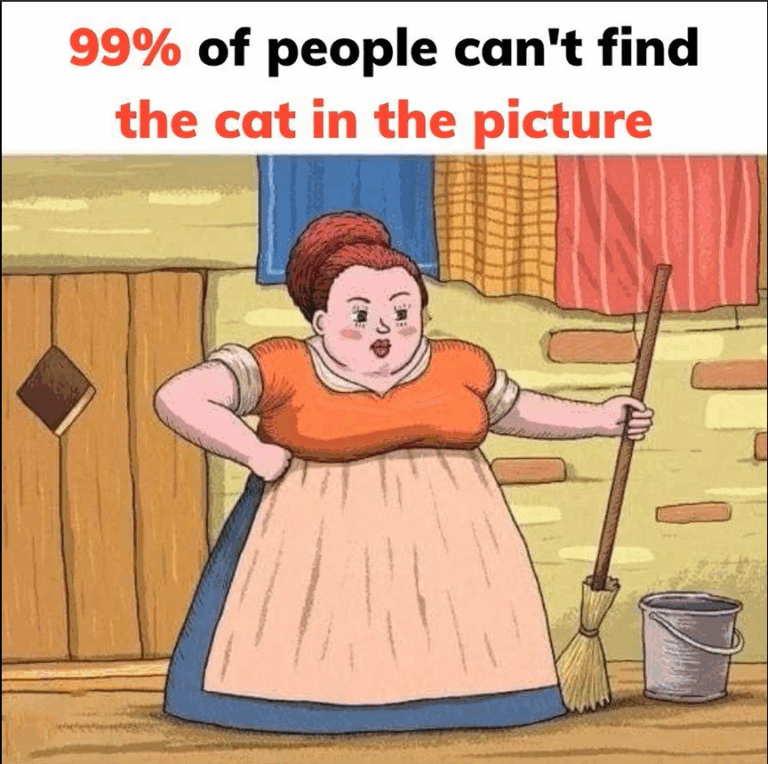
The image in question portrays a calm domestic scene: a woman stands inside a cozy, well-decorated room, holding a broom.
The environment feels warm and inviting, featuring colorful walls, carefully arranged furniture, and soft lighting that enhances the homely atmosphere.
At first glance, nothing seems unusual. The room appears ordinary, almost mundane, in its details. However, the challenge lies precisely in this normality.
Hidden somewhere within this seemingly simple setting is a cleverly camouflaged cat, integrated into the design so that it is easily overlooked.
According to the original social media post, 99% of viewers fail to locate the feline on their first attempt. Judging by the thousands of comments and interactions online, this statistic seems entirely plausible, as many users report staring at the image for several minutes without success.
Viewers often describe a sense of disbelief while searching. Some initially assume that the challenge is a hoax or that the cat might not even exist. Yet, despite appearances, the feline is genuinely present, requiring careful observation to discern its location.
What makes the puzzle particularly engaging is how seamlessly the cat has been incorporated into the scene. Unlike traditional hidden object challenges, this puzzle does not place the cat in an obvious location, such as beneath furniture or perched on a surface, but rather embeds it within the environment itself.
The artist responsible for the illustration has masterfully used shadows, textures, and color gradients to obscure the cat’s presence. The feline blends almost imperceptibly with the room’s elements, demonstrating an understanding of human perception and visual attention.
As you examine the image, your eyes may initially fail to recognize the subtle shapes that form the cat’s outline. The human brain tends to filter out what seems familiar or unimportant, and this puzzle exploits that tendency, making the hidden feline challenging to perceive.
The woman in the image holds a broom, and her posture conveys calm and routine activity. Her clothing, particularly the folds of her dress and apron, are rendered with intricate detail, creating patterns that further disguise the cat’s presence within the background.
To locate the feline, viewers are encouraged to shift their focus from obvious objects to the nuanced patterns and shapes that make up the environment. Observing the walls, textiles, and even small decorative elements can reveal subtle hints of the hidden creature.
The cat itself is drawn with soft, subdued features. Its silhouette, tail, and ears are integrated into the background’s textures, preventing immediate recognition. The coloring of the cat matches elements of the room, making contrast insufficient to detect it at a casual glance.
Once discovered, the cat’s position surprises many viewers. They often report feelings of both satisfaction and mild embarrassment, realizing that the figure was visible all along. This psychological reaction highlights how perception is shaped by expectations and assumptions.
Interestingly, this puzzle demonstrates fundamental principles of visual cognition. Humans often focus on salient objects or bright contrasts, filtering out information that blends into the context. Puzzles like this reveal how easily our perception can be deceived.
The design also incorporates principles of Gestalt psychology. The cat’s form is suggested through continuity, closure, and figure-ground relationships, requiring viewers to mentally complete the image to perceive the hidden figure correctly.
For those struggling to find the feline, a useful strategy is to examine the intersections of lines and colors within the room. Small inconsistencies, subtle curves, or shadowed areas may provide the clue necessary to identify the cat.
Focusing attention on areas around the woman’s apron, her dress folds, or the wall textures often leads to discovery. The cat is positioned so that its outline is implied rather than explicit, forcing observers to detect patterns that are not immediately obvious.
This type of puzzle is intellectually stimulating because it challenges automatic visual processing. The brain must slow down and reassess assumptions, often requiring multiple passes over the image before the hidden element becomes apparent.
The experience of finally spotting the cat provides a sense of triumph. Viewers report the satisfaction of overcoming perceptual blind spots and recognizing a detail that was present but unnoticed, reinforcing the enjoyment of cognitive challenges.
Social media users frequently share their reactions, noting how the cat’s concealment demonstrates the difference between seeing and truly observing. Many acknowledge that their initial frustration transforms into delight once the hidden figure is found.
The popularity of such puzzles stems not only from the challenge itself but also from their educational value. They encourage mindfulness, patience, and attention to detail, skills applicable in many aspects of life beyond online games or illustrations.
Artists creating these puzzles often spend hours planning the composition. Balancing visual harmony with subtle concealment requires careful manipulation of color palettes, shadows, and pattern repetition to ensure the hidden object is neither too easy nor impossibly difficult to detect.
In this particular illustration, the choice of colors is critical. Warm tones dominate the scene, blending seamlessly with the muted grays and browns of the cat, a decision that increases the puzzle’s difficulty while maintaining aesthetic appeal.
Lighting plays a subtle but significant role. The soft, diffused illumination creates shadows that naturally obscure the feline’s contours. Highlights and reflections are minimized around the cat, preventing the viewer from noticing incongruities in the room’s visual structure.
Texture is another crucial factor. The folds in the woman’s dress, the patterns on the walls, and the brushstrokes used to render furniture surfaces all contribute to camouflage, effectively making the cat part of the environment rather than a separate object.
The cat’s positioning is deliberate, encouraging viewers to examine areas typically overlooked. Peripheral vision may register shapes without consciously acknowledging them, prompting a second or third closer look to resolve the visual ambiguity.
This puzzle also illustrates the phenomenon of inattentional blindness, where the human mind ignores objects that do not align with expected context. Observers often focus on the woman and room elements, missing subtle forms within the background.
The sense of accomplishment upon discovering the cat is amplified by its invisibility. The brain experiences a “light bulb” moment, realizing that careful observation and altered perspective reveal hidden information previously unnoticed.
Sharing these puzzles on social media amplifies the effect. Users post screenshots, comment on their strategies, and discuss how long it took to find the hidden feline, creating a community around observation, attention, and cognitive exploration.
For educators and cognitive scientists, puzzles like this provide insight into visual perception and attention. They demonstrate how humans prioritize, filter, and interpret sensory information in complex environments.
Engaging with such challenges can improve focus and analytical skills. By training the brain to notice subtle differences and unexpected details, individuals enhance their ability to detect patterns, an essential skill in both creative and professional settings.
Even small details can act as triggers for recognition. In this image, slight deviations in wall texture or the alignment of shadows act as cues, eventually allowing the brain to isolate the cat’s form from the surrounding environment.
The psychological impact is significant. Success in spotting hidden objects provides not only entertainment but also reinforces confidence in observation and reasoning, rewarding patience and persistence with visible results.
Many viewers describe the puzzle as “deceptively simple,” noting that ordinary domestic elements hide extraordinary complexity. This juxtaposition between everyday familiarity and hidden detail makes the experience uniquely engaging and memorable.
The artist’s skill lies in creating a scene that feels natural while simultaneously embedding a challenge. This requires mastery of composition, color theory, and visual storytelling to ensure the image captivates without overtly signaling the puzzle.
Interestingly, repeated exposure to similar puzzles enhances perceptual ability. Individuals trained in observation begin to notice subtle patterns more quickly, demonstrating how cognitive exercises can develop mental acuity and attention to detail.
Parents and educators have also recognized the value of such puzzles. They can be used as tools to teach children patience, careful observation, and problem-solving, all while making the activity enjoyable and engaging.
The hidden cat in this particular image has inspired widespread discussion about the interplay between art and perception. It exemplifies how creative visuals can stimulate cognitive processing and elicit strong emotional responses simultaneously.
Some viewers note that the cat appears almost like a ghostly silhouette. Its subdued features challenge assumptions about figure-ground distinction, teaching a subtle lesson about how the mind fills in missing information to construct reality.
The puzzle is a reminder that attention to detail is often a skill developed, not innate. By consciously slowing down and analyzing patterns, shapes, and colors, even the most elusive objects can be discovered with time and patience.
The enjoyment of such brain teasers extends beyond mere challenge. They foster appreciation for artistry, design, and the intricate ways visual elements can communicate, deceive, and delight simultaneously.
Ultimately, the puzzle encourages viewers to question initial perceptions. The hidden cat demonstrates that what seems obvious at first glance may conceal complexity, and careful observation can reveal surprising truths hidden in plain sight.
For those who fail initially, repeated attempts build resilience. The image becomes a mental exercise in perseverance, teaching that careful attention and methodical searching yield reward, a principle applicable beyond visual puzzles.
This particular challenge exemplifies how digital media has transformed traditional puzzles into social phenomena. Platforms like Twitter, Instagram, and Reddit enable widespread sharing, discussion, and collaborative problem-solving.
Viewers often report increased enjoyment when discovering the cat without hints. Being part of the rare group capable of spotting the hidden figure independently provides both satisfaction and social bragging rights in online communities.
The experience of observation also enhances mindfulness. As individuals slow their gaze, analyze textures, and re-evaluate assumptions, they engage fully with the present moment, making the puzzle a form of meditative cognitive exercise.
Even after locating the cat, viewers often return to the image to appreciate its design. The subtle integration, balanced color palette, and meticulous placement of details reveal the artist’s careful consideration and mastery of visual storytelling.
Hidden object puzzles, including this one, highlight the relationship between perception and expectation. The human brain prioritizes salient features while filtering repetitive or familiar information, a mechanism leveraged by artists to create engaging challenges.
By studying such images, one can better understand the limitations and capabilities of human attention. Puzzles illustrate how contextual cues, contrast, and prior knowledge influence the way we interpret visual information in everyday life.
In conclusion, this hidden cat puzzle demonstrates that even seemingly simple images can hold complex cognitive challenges. It blends artistry with psychology, offering entertainment, education, and insight into human perception, all in a single visually rich scene.
Viewers are reminded to slow down, adjust their perspective, and carefully examine patterns, textures, and shapes. With persistence and focus, even the most cleverly hidden object can be discovered, revealing both the image’s secret and the observer’s enhanced perception.
The hidden cat challenge is more than a simple game—it’s an exercise in patience, observation, and critical thinking. It encourages viewers to embrace curiosity, question assumptions, and experience the satisfaction of discovery in a tangible, rewarding way.

