
It had always been just the two of us—my dad and me. My mother died the day I was born. I never knew her smile, her voice, or the way her presence could fill a room.
From the very first moment I entered the world, it was just Dad—Johnny—standing between me and everything unknown, everything scary. He became everything at once: mother, father, guardian, and best friend.
Dad had this quiet, unshakable way of showing love. He packed my lunches every morning before leaving for work, sometimes waking up at 5:30 a.m. just to make sure I had a sandwich, a fruit, and a note tucked into my lunchbox—little messages like, “You’re going to do amazing today,” or “Don’t forget to smile, sweetheart.”
Sundays were sacred. He never missed making pancakes. He had a routine, a rhythm to life that made our small home feel safe, even when the world outside wasn’t.
By the time I was in second grade, Dad had even taught himself how to braid hair. He watched countless YouTube tutorials, practicing late into the night on a small mirror he had taped to the bathroom wall.
The first few attempts were messy, full of knots and pulled strands, but he kept going until he could make my braids look neat, just the way I liked them.
Dad worked as the janitor at the very school I attended, and growing up with that truth was… complicated. Kids are cruel without trying to be. I heard the whispers and the laughter long before I fully understood their meaning.
“Her dad scrubs our toilets.”
“That’s the janitor’s kid. Bet she doesn’t even know which classroom she belongs in.”
I never cried in front of them. Never. Instead, I bottled it all up until I got home, walking through the front door like nothing had happened. And somehow, Dad always knew.
He had this way of seeing through me, this radar for every pang of hurt, every invisible tear. He would slide a plate of food across the kitchen table, look me in the eye for a heartbeat, and then quietly say,
“You know what I think about people who make themselves feel big by making others feel small?”
I’d shrug, trying to blink away the tears threatening to spill.
“Not much, sweetie. Not much at all,” he’d continue, with a tiny, reassuring smile.
That was enough. Always enough.
Dad had a deep belief in honest work, in dignity, in taking care of things that others overlooked. He often said, “People see the big things, the flashy things, and forget the quiet effort it takes to keep the world running.” I believed him.
By the time I reached sophomore year, I had made a silent, unwavering promise to myself: one day, I would make him so proud that those whispers, those pointed looks, those casual cruelties—they would mean nothing.
But life has a way of testing even the strongest promises.
Last year, everything changed. Dad was diagnosed with cancer.
The news shattered me, though I tried to hold it together in front of him. The man who had never let a single child’s locker be broken, never let a student’s torn backpack go unrepaired, now faced a battle that not even his resilience could conquer alone.
Even after the diagnosis, he kept going to work for as long as the doctors would allow. He was relentless. Sometimes, I would find him leaning against the supply closet in the hallway, shoulders slumped, eyes heavy with exhaustion.
His uniform, once crisp and tidy, now seemed to hang from his frame like it was too big for him. And yet, the moment he saw me, he straightened up with a grin that didn’t quite reach his eyes.
“Don’t give me that look, honey,” he’d say. “I’m fine.”
But we both knew he wasn’t.
Still, there was something he clung to even in the darkest moments, a small light he carried to keep me buoyed. Over dinner, after dragging himself home from another long shift, he would always talk about prom.
“I just need to make it to your prom,” he said one evening, rubbing his tired eyes. “And then graduation. I want to see you walk out that door dressed up like you own the world, princess.”
“You’re going to see way more than that,” I told him, my own voice trembling despite my efforts to sound confident.
But the universe is crueler than we sometimes realize. A few months before prom, Dad lost the fight. He passed away quietly, without fuss, before I could even make it to the hospital.
I found out standing in the hallway at school, backpack still slung over one shoulder, staring at the linoleum floors—the same floors he had scrubbed, polished, and cared for every day of my life. And then everything blurred. The world became a haze of sound, color, and pain.
The week after the funeral, I moved into my aunt’s house. Her spare bedroom smelled of cedar and fabric softener, a scent so foreign compared to the faint, comforting smell of my home with Dad. Everything felt temporary, hollow, like I was drifting in someone else’s life.
Then prom season arrived. The hallways buzzed with conversations about designer gowns, glittering shoes, and hairdos that took hours to perfect.
Screenshots of dresses that cost more than my dad made in a month circulated like currency. I listened quietly from the edge of conversations, feeling like an invisible spectator in a world that once felt mine.
Prom had always been our moment. I pictured it clearly: Dad standing by the front door, phone in hand, snapping too many photos, pretending he knew exactly how formal events worked. The memory of his grin, proud and a little awkward, made the emptiness in my chest ache even more. Without him, everything felt hollow.
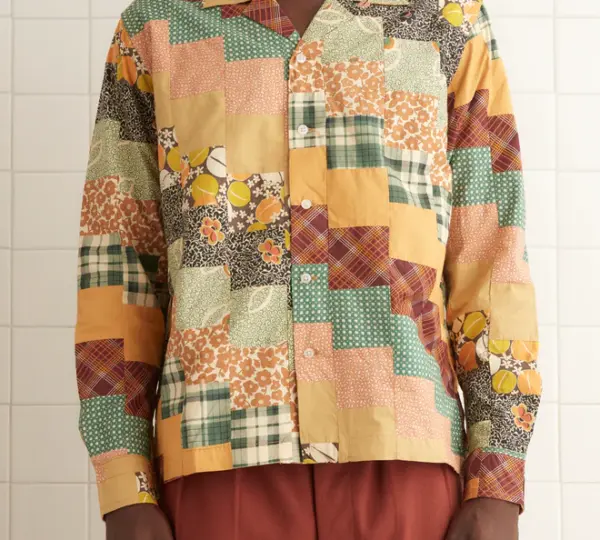
One evening, as I unpacked the small box of Dad’s things that the hospital had returned, I found his wallet, his cracked watch, and at the bottom—folded perfectly, the way he folded everything—his work shirts. Blue, gray, and a faded green one I remembered from years ago.
I held one of the shirts for a long, long time, letting the memory of him wash over me. And then the idea struck, as clear as sunlight breaking through clouds: if Dad couldn’t be there with me, I would bring him with me.
“I barely know how to sew,” I admitted nervously to my aunt the next day.
“I know,” she replied, calm and certain. “I’ll teach you.”
And she did.
That weekend, we spread his shirts across the kitchen table and opened her old sewing kit. The pins glinted in the sunlight, the scissors were sharp and precise, the needles tiny but resilient. The process took longer than I expected. I cut fabric wrong more than once.
I ripped seams out. I re-did entire sections. My hands ached. Some nights, I cried while I worked. Other nights, I talked to Dad out loud, telling him about the whispers, the prom, the way I missed him. Each piece of fabric became a memory:
-
The blue shirt he wore on my first day of high school, when he whispered, “You’re going to be amazing,” as he held my backpack.
-
The faded green shirt from the afternoon he ran beside my bike until his knees gave out, just to keep me safe.
-
The gray shirt from the day he hugged me after my worst day in junior year, without asking a single question.
Every stitch carried him with me. Every seam was a conversation. Every patch was a fragment of love, laughter, protection, and pride.
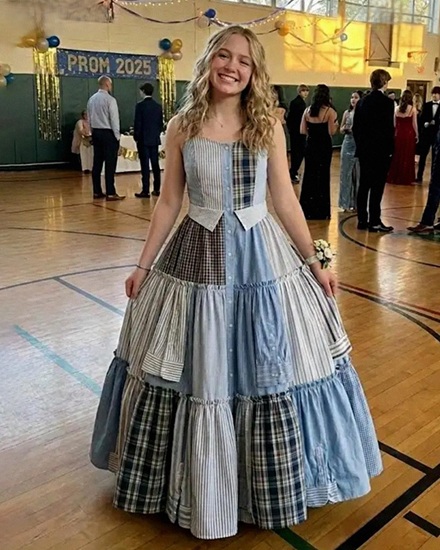
The dress became more than just clothing. It became a tapestry of our life together, of everything Dad had been and everything he had taught me. By the night before prom, it was finished.
I put it on and looked in the mirror. It wasn’t a designer gown. Not by any measure. But every color, every fold, every seam spoke of a man who had given his life to caring for me, for our small home, and for the students of that school who never noticed his labor but benefited from it every day.
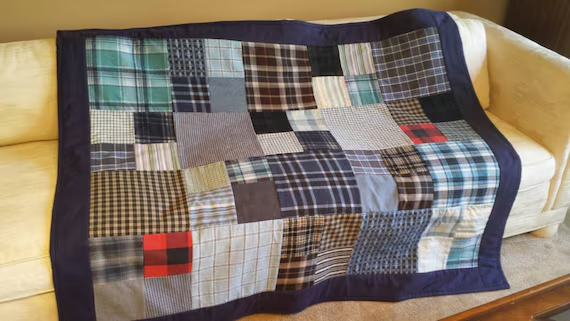
For the first time since the hospital call, I didn’t feel empty. I felt like he was right there with me, present in the fabric, in the memory, in my heartbeat.
Prom night arrived in a blur of lights, music, and glittering dresses. The whispers started before I even reached the center of the room.
“Is that made from the janitor’s rags?”
A boy laughed loudly. “Guess that’s what you wear when you can’t afford a real dress.”
The laughter spread across the hall like a ripple on a pond. My face burned. I felt every stare, every judgmental glance, every remembered insult.
“I made this dress from my dad’s shirts,” I said, my voice shaking but steady. “He passed away a few months ago. This is how I’m honoring him.”
Someone rolled their eyes. “Relax. Nobody asked for the sob story.”
For a moment, I felt eleven years old again, standing in a hallway, hearing people whisper that my father cleaned their toilets. I sank onto a table near the edge of the room, hands clenched tightly in my lap, trying to hold myself together.
Then, something unexpected happened.
The music stopped. The DJ stepped back. And our principal, Mr. Bradley, walked to the center of the hall, holding a microphone.
“Before we continue,” he said calmly, his voice cutting through the chatter, “there’s something I need to say.”
The room went silent, all eyes on him.
“For eleven years,” he continued, “Nicole’s father, Johnny, took care of this school. He fixed lockers so students wouldn’t lose their belongings.
He sewed torn backpacks and returned them without anyone knowing. He washed sports uniforms before games so that no student had to admit they couldn’t afford the laundry fee.”
No one spoke.
“That dress,” he said firmly, “is not made from rags. It is made from the shirts of a man who cared for every person in this building.”
Then he added, “If Johnny ever helped you—fixed something, repaired something, did something you didn’t notice at the time—I’d like you to stand.”
For a moment, nothing happened. Then a teacher rose. Then a boy from the track team. Then two girls by the photo booth. Slowly, more and more people stood. Students, teachers, chaperones—within minutes, more than half the room was on their feet.
Applause erupted, echoing through the hall. This time, I wasn’t alone. This time, I was surrounded by people who had seen, even if silently, the care my father had given, the quiet labor of love he had performed every day.
When Mr. Bradley handed me the microphone, my throat was tight, words scarce.
“I made a promise a long time ago to make my dad proud,” I managed, voice wavering. “I hope I did. And if he’s watching tonight, I want him to know that everything I’ve done right is because of him.”
Later that night, my aunt drove me to the cemetery. The grass was damp, cool beneath my fingers. The sunset painted the sky in streaks of gold and pink. I knelt beside Dad’s headstone, my hands pressed against the marble.
“I did it, Dad,” I whispered. “You were with me the whole time.”
He never got to see me walk into that prom hall. He never got to see the pride in my smile, the way my friends looked at me, or the whispers turn into applause. But I made sure he was dressed for it anyway, in every stitch, every patch, every color of that dress.
And for the first time in months, I felt whole.
Because love doesn’t end. Not with death. Not with absence. Not with whispers meant to tear you down. Love carries forward, woven into the fabric of memory, into every stitch, into every moment we choose to honor it.
That night, under the gold and pink sky, with my father’s shirts around me, I realized something profound: the people who truly matter never leave. They are stitched into your life, into your heart, into the very clothing you wear to walk through the world proud and unafraid.
And in that moment, I knew that no matter what anyone else said, my father’s dignity, his love, and his unwavering strength would always be the most beautiful garment I could ever wear.

