
I used to pride myself on being able to spot a lie from a mile away. My mother, Nancy, had raised me on a diet of straight lines and straight talk.
Her rules were clear, unwavering, and delivered with a tone that left no room for argument. Keep your porch clean. Keep your hair brushed.
Keep your secrets buried so deep that no one, not even yourself, could ever stumble over them. As a child, I absorbed these instructions like sunlight.
By the time I was thirty-eight, I believed I had mastered this philosophy. I had a tidy life, a predictable one. I was a mother of two, a wife to a charming, reliable man, and the unofficial commander of our block’s neighborhood watch spreadsheet.
Most of my internal conflicts were trivial, revolving around whether tulips or daffodils would look better by the mailbox or whether our grass needed another trim before the weekend. My life was orderly, measured, and comforting.
Then Mr. Whitmore died. The news hit our block like a sudden frost in April. Mr. Whitmore had been our neighbor for as long as I could remember — a quiet man, solitary but not unfriendly.
He never seemed to intrude, but he observed, kept track, and somehow knew everything happening on our street. After his funeral, I felt a peculiar emptiness, as if a fixture of my life had vanished, leaving a blank space that seemed too vast to fill.
That morning, when I returned from the service, I found a thick envelope in my mailbox. My name was written in looping blue ink — careful, deliberate, almost elegant.
Richie, my husband, stepped onto the porch behind me, coffee mug in hand. “What’s up?” he asked, squinting at the envelope.
I hesitated. “It’s from Mr. Whitmore.” His brow furrowed in confusion. “Why would a dead man send you a letter?” I didn’t have an answer.
All day, the letter burned in my pocket, a smoldering secret I couldn’t yet bear to face. It was only after the kitchen was cleaned, the children were bathed, and dinner simmered quietly on the stove that I opened it. The handwriting was familiar, steady, and precise.
Even in that opening line, I felt a jolt, a strange mix of familiarity and shock. The letter was short but potent, heavy with the weight of decades-long concealment.
“If you’re reading this, I’m no longer here. This is something I’ve been hiding for forty years. In my yard, under the old apple tree, a secret is buried, one I’ve been protecting you from. You have the right to know the truth, Tanya. Don’t tell anyone about this.”
—Mr. Whitmore Richie leaned closer, resting a hand on my shoulder. “This… this doesn’t make sense. Why would he send you to dig in his yard?” I shook my head. “I don’t know. I just… I have to.”
That evening, I stood by the back window, watching the gnarled branches of the old apple tree sway in the breeze. The blossoms were fragile, white and pink petals trembling as if whispering secrets.
I couldn’t stop staring at that tree. It had always been there, a silent witness to my life, yet I had never looked at it closely, never wondered what stories it could tell.
“I’ll go with you,” Richie said softly, wrapping his arms around my waist. “You don’t have to do it alone.”
But the next morning, as the sun stretched across the sky in pale amber streaks, I crossed into Mr. Whitmore’s yard by myself.
Each step felt like crossing into forbidden territory, like stepping back in time or into a memory that wasn’t mine. The apple blossoms above me shivered in the morning light. I felt both intruder and child, a delicate balance between fear and curiosity.
The shovel cut through the earth easily, almost too easily, as though it had been waiting for me. Dirt sifted through my fingers and fell to the grass in little clumps.
Then, after a few tense minutes, a harsh, metallic scrape echoed in the quiet morning. My heart thumped, loud enough to drown out the wind.
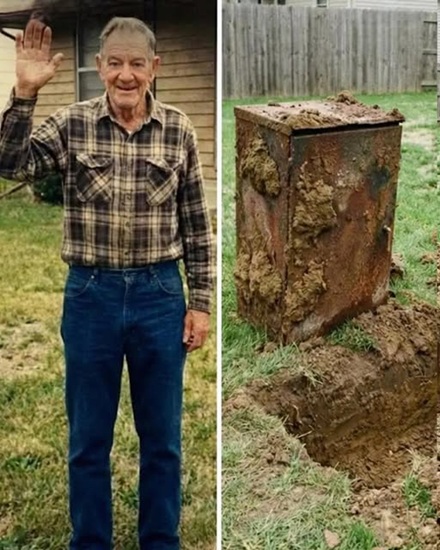
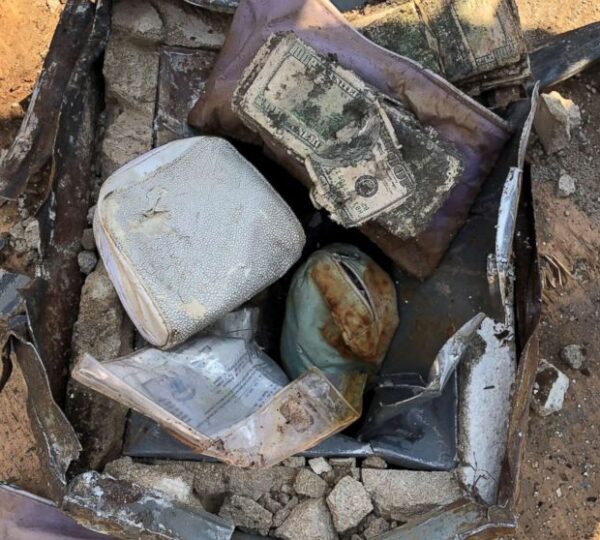
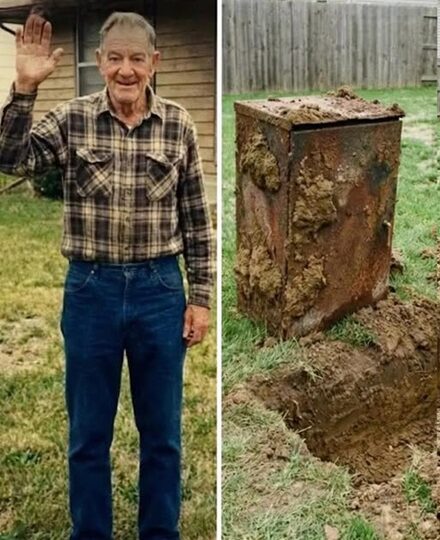
I knelt, brushing away the soil, and unearthed a rusted metal box. Its edges were corroded, but the lock had long since succumbed to time. Inside was a photograph.
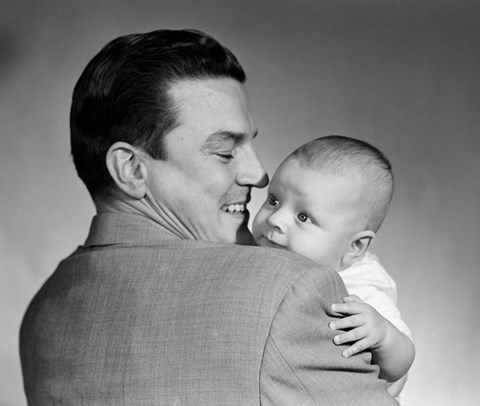
The image made my stomach drop, twisted something inside me into unfamiliar shapes. It was a man in his thirties, holding a newborn under the harsh glare of hospital lights.
Beside the photo, tucked neatly, was a hospital bracelet, my birth name printed in block letters. I could barely breathe. “No,” I whispered, shaking. “That’s… that’s me.”
Beneath the photograph lay another letter, its edges frayed but the ink crisp and readable.
“My darling Tanya,” it began, “I did not abandon you. I was removed. Your mother was young, and her family thought they knew best. I contacted Nancy once.
She told me where you lived. I moved nearby so I could watch you grow without hurting you, or her. You deserve more than secrets. I am your father. All my love, always.”
The words blurred before my eyes. I sank into the dirt, clutching the photo, trembling. My life, which had always been orderly, fractured completely in that instant.
The identity I had assumed, the narrative I had lived by, had been shattered by a single envelope.
Richie found me sitting under the apple tree, knees muddy, face streaked with tears. His expression was a mixture of confusion, concern, and disbelief. “Tan… what happened?”
I handed him the letter. His eyes widened as he read, and the world seemed to shrink around us. “He was your father?” he asked softly.
I nodded, unable to speak. The magnitude of the revelation weighed on me, pressing down like a heavy fog. “He lived next door,” I whispered. “All this time.”
Later that day, I called my mother. When she arrived, she was her usual composed self — brisk, tightly controlled, and seemingly unflappable.
But the moment she saw the photograph, the color drained from her face. Her hands trembled, the lines around her mouth deepening as if decades of restraint had suddenly cracked.
“Why were you digging in his yard?” she asked, her voice weak, almost fragile.
“I went because he asked me to,” I replied. “After his funeral.”
Her shoulders sagged. She looked at me not as the mother I knew, but as the young woman she once had been. “I was nineteen,” she whispered.
“My parents threatened to throw me out if I stayed with him. They said he’d ruin my life. I thought I was protecting you.”
“You let him live right next door,” I said, voice shaking. “You let me grow up thinking he abandoned me.”
“I thought it would be simpler,” she admitted. “I didn’t want you to hate me.”
I looked at her — truly looked — seeing her as a frightened teenager making impossible choices under pressure. “You didn’t protect me,” I said quietly. “You protected yourself.”
Her face fell, and she didn’t argue. She didn’t deflect. It was a simple acknowledgment of a truth that had been buried for decades. The words hung in the room like fragile glass, delicate and irrefutable.
The following week was a storm of whispers, phone calls, and opinions from friends and family. At a Sunday family dinner, Aunt Linda’s voice rang loudly across the table. “Your mother did what she had to do,” she declared, looking directly at me.
I set down my fork, calm but resolute. “No,” I said firmly. “She did what was easiest. I’m allowed to be hurt.”
The table fell silent. Even my mother, usually quick with correction or deflection, didn’t argue. She only nodded, a small, simple gesture that carried weight far heavier than any words could convey.
“I’m sorry,” she said, and for the first time, it didn’t sound rehearsed. It sounded human. Vulnerable. Real.
That Sunday, I brought a small bouquet of apple blossoms to Mr. Whitmore’s grave. The wind carried the petals in soft spirals around me as I knelt, placing the flowers gently on the earth. “I wish you’d told me sooner,” I whispered, voice barely audible above the rustle of leaves. “We could have had more time.”
Grief, I realized, does not disappear with truth. It reshapes itself, morphing into new forms, new aches. I had lost a father twice — once without knowing, and once with clarity.
As for my mother, the fracture between us may never fully heal. Forgiveness is not a switch one flips because someone apologizes, and trust cannot be rebuilt with a single confession.
But something essential had shifted. The secret was no longer buried. And for the first time in my life, I knew exactly where I came from. No one could dig that up again, no one could hide it.
In the following weeks, I found myself replaying moments from my childhood with new eyes. Small details that once seemed mundane suddenly carried new weight.
The quiet figure at the fence line, who I had assumed was just another neighbor, was actually my father, watching over me from the shadows.
The lessons about privacy and decorum my mother drilled into me were not just about tidiness — they were shields against a reality she feared I could not yet understand. I began to see my parents not as perfect, but as people, with fears and flaws, love and regret intertwined.
Richie became my anchor through this storm of revelation. Each night, we sat together in the living room after the children had gone to bed, unpacking memories, piecing together fragments of stories I had never known.
He never told me to stop, never urged me to forget. Instead, he listened, asked questions, and helped me process the profound reshaping of my identity.
As for my daughters, I was careful. I didn’t yet know how to explain the complexities of loss, secrecy, and the tangled threads of family. I told them small truths, pieces they could understand, and let the rest wait until I myself could find the words.
In that fractured clarity, I realized that life is not measured by perfect moments, but by the threads we weave between truth and discovery, love and regret.
My orderly, controlled world may never fully return, but I now inhabit it with a deeper understanding — of my parents, of myself, and of the enduring power of secrets finally laid bare.
Standing once more beneath the apple tree, I traced my fingers along its rough bark. Its branches, still delicate with early spring blossoms, seemed to hold a quiet wisdom.
I no longer saw it as a simple landmark of my childhood, but as a sentinel, a keeper of truths. And in that quiet, I felt a strange, fragile peace.
I was no longer the child who believed in straight lines and buried secrets. I was someone who understood that life’s truths are often hidden in plain sight, waiting patiently for us to find them, ready or not.
And in that knowledge, I felt ready to move forward — not with certainty, but with honesty.

