
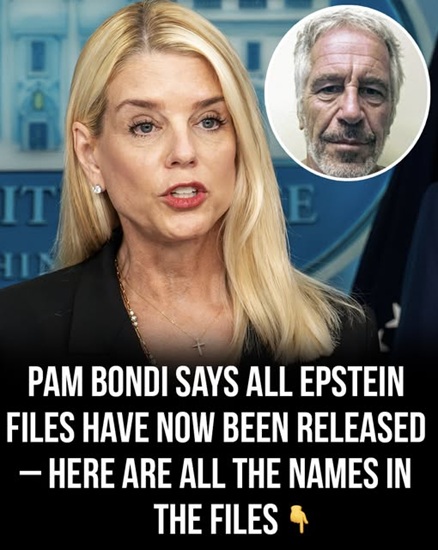
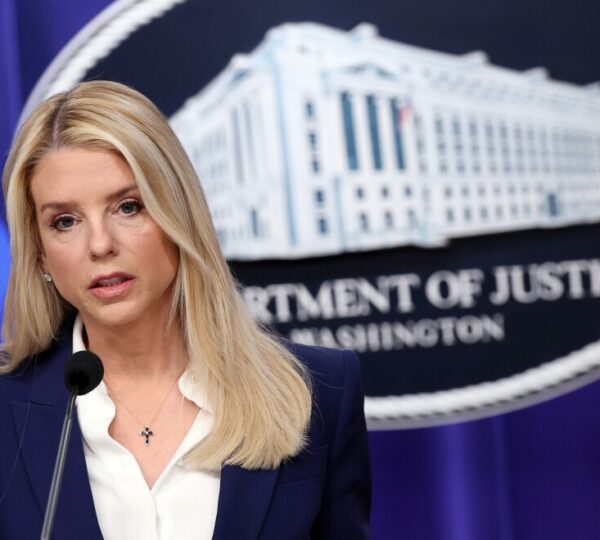
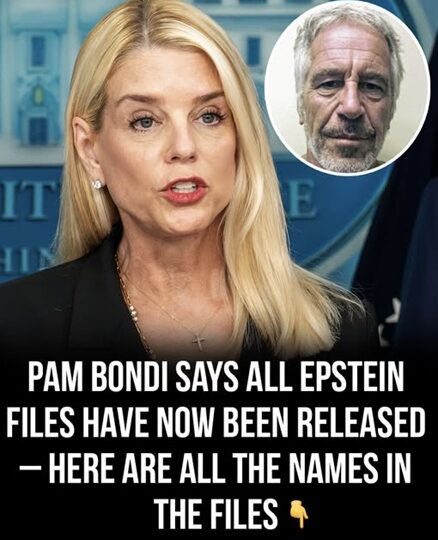
U.S. Attorney General Pam Bondi has officially confirmed that the Department of Justice (DOJ) has completed the public release of documents connected to the late convicted financier Jeffrey Epstein.
Marking a significant milestone in one of the most scrutinized investigations into financial crime and sexual abuse networks in recent history.
The confirmation comes through a formal letter dated February 14, in which Bondi stated that all materials mandated under Section 3 of the Epstein Files Transparency Act have now been made publicly available.
The move follows months of methodical document disclosures in December and January, which included a meticulous review of millions of pages of emails, photographs, and investigative records by federal staff.
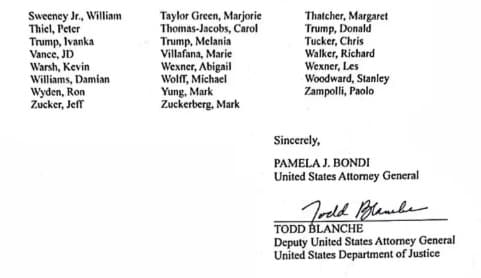
According to the Department of Justice, the final batch of materials includes references to more than 300 high-profile individuals.
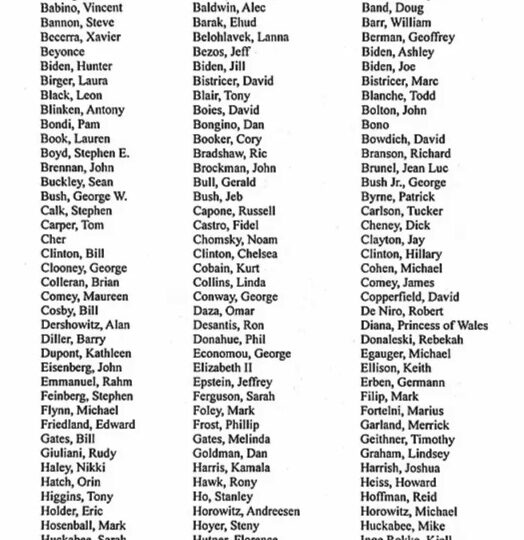
Bondi emphasized that the documents have been compiled in two distinct categories: one general set of references and a separate compilation specifically highlighting individuals who are or were government officials or politically exposed persons.
This approach ensures that public figures are clearly identified while also distinguishing them from other references that may appear in the documents.
Bondi made clear that the inclusion of any individual in the released materials does not imply criminal involvement or wrongdoing.
“References appear in a wide variety of contexts,” she wrote in her letter. “Being named does not assume any guilt or wrongdoing with respect to Epstein’s criminal activities.”
She further asserted that no documents were withheld or redacted on the basis of potential embarrassment, reputational harm, or political sensitivity, including for government officials, public figures, or foreign dignitaries.
This statement addresses longstanding concerns that sensitive political or social reputations may have influenced prior document withholding.
The released materials contain a broad spectrum of names spanning political leaders, members of royalty, entertainment figures, and deceased cultural icons.
Among the notable individuals referenced are Donald Trump, Bill Gates, Barack and Michelle Obama, Benjamin Netanyahu, Princess Diana, and Bill and Hillary Clinton. In addition, the release lists prominent cultural figures, including Barbara Streisand, Amy Schumer, Bruce Springsteen, Kim Kardashian, Bill Cosby, and Robert De Niro, as well as legendary deceased performers such as Janis Joplin and Elvis Presley. Bondi’s letter clarified that many of these references are tangential in nature, such as mentions in news articles, email chains, or social events, while some individuals had documented communications with Epstein or his associate, Ghislaine Maxwell.

Deputy Attorney General Todd Blanche, who co-signed the release letter with Bondi, highlighted that while many names appear in the materials, the context of each reference varies significantly.
“The only category of records withheld were those where permitted withholdings under Section 2(c) and privileged materials were not segregable from material responsive under Section 2(a),” Blanche stated.
The referenced privileges include deliberative-process protections, attorney-client privilege, and work-product protections, which are standard legal safeguards in federal investigations to maintain the integrity of sensitive internal communications.
Despite the DOJ’s declaration that the public release satisfies the statutory requirements of the Epstein Files Transparency Act, some lawmakers have voiced concerns that additional transparency remains necessary.
Representative Thomas Massie (R-Ky.), who co-authored the Transparency Act alongside Representative Ro Khanna (D-Calif.), emphasized that the legislation mandates the disclosure of internal decision-making documents.
Speaking on ABC’s This Week, Massie explained, “The problem with that is the bill that Ro Khanna and I wrote says that they must release internal memos and notes and emails about their decisions on whether to prosecute or not prosecute, whether to investigate or not investigate.”
Massie’s remarks underscore ongoing debate over the completeness of the DOJ’s disclosures and whether the public can access the full scope of the department’s internal deliberations.
Representative Khanna also criticized the structure of the release, noting that the list of names lacks adequate context.
He specifically highlighted instances where historical figures, such as Janis Joplin, who died in 1970—decades before Epstein’s criminal activities became publicly known—appeared alongside convicted offenders, potentially leading to misleading interpretations.
Khanna took to social media platform X, urging, “Release the full files. Stop protecting predators. Redact only the survivor’s names.”
His call reflects a broader concern among legislators and advocates that partial disclosure can inadvertently shield wrongdoing while sowing public confusion.
Attorneys representing Epstein’s victims have expressed similar concerns regarding privacy and security. While the Transparency Act aims to ensure public access to information, some of the released materials reportedly included sensitive details, such as email addresses and explicit images that could inadvertently identify survivors.
The DOJ acknowledged that certain documents were temporarily posted in error due to technical or human mistakes, and those materials were promptly removed once identified.
This corrective action highlights the challenges in balancing transparency with survivor protection, as well as the complexity of releasing millions of pages of investigative records without compromising privacy.
The Department of Justice maintains that it has complied fully with the statutory requirements of the Epstein Files Transparency Act.
Bondi and Blanche’s joint statement clarified, “In accordance with the requirements of the Act… the Department released all ‘records, documents, communications and investigative materials in the possession of the Department’ that ‘relate to’ any of nine different categories.”
The scope of the release encompasses investigative records, internal communications, and other materials relevant to understanding the extent of Epstein’s criminal operations and the federal response to them.
Experts analyzing the release note that while it represents an unprecedented level of public access to investigative records, significant questions remain.
Legal scholar Jennifer Naughton, an expert in federal transparency law, commented, “The release is historic in scope and provides valuable insights into how federal authorities investigated Epstein and his network.
However, the lack of full contextualization—especially regarding the decisions not to prosecute certain individuals—limits the public’s ability to fully understand the reasoning behind investigative choices.”
Naughton emphasized that while names of prominent figures are included, the documents themselves require careful review to avoid misinterpretation.
Several key themes emerge from the newly released materials. First, they underscore Epstein’s extensive connections across financial, political, and entertainment circles, illustrating how he leveraged wealth and influence to gain access to high-profile individuals.
Second, the materials reveal the intricate coordination between Epstein and Ghislaine Maxwell, including documented communications that provide insight into recruitment and management of underage victims.
Third, while the documents shed light on interactions and potential associations, they do not inherently indicate culpability, highlighting the DOJ’s repeated disclaimers regarding the meaning of inclusion in the files.
Among the documents are hundreds of emails, financial records, and photographs that provide a timeline of Epstein’s operations, as well as interactions with his associates and notable individuals.
For instance, the communications show instances of invitations to private events, discussions regarding philanthropic initiatives, and routine social correspondence.
Legal analysts caution that such documents often require careful interpretation, as casual mentions or appearances in social contexts do not constitute evidence of illegal activity.
The release has reignited public debate about accountability and transparency in cases involving high-profile offenders. Victim advocacy groups, such as Victims’ Rights Coalition, have praised the DOJ for releasing the files but emphasize that redactions should not obscure the identification of potentially complicit individuals while simultaneously protecting survivor privacy.
“Survivors deserve both protection and the assurance that those who exploited them are not shielded by bureaucratic technicalities,” said coalition spokesperson Maya Thompson.
Media organizations have begun combing through the documents, highlighting notable communications, historical references, and financial records that offer a more complete picture of Epstein’s network.
Investigative journalists emphasize the importance of distinguishing between documented evidence of wrongdoing and incidental mentions of public figures to prevent the spread of misinformation.
Many outlets are using the release to create timelines and case studies that contextualize Epstein’s activities within broader patterns of exploitation and financial misconduct.
The public release also raises questions about the effectiveness of prior federal investigations into Epstein. Lawmakers, legal scholars, and journalists are scrutinizing how federal authorities initially handled allegations, plea agreements, and subsequent investigations.
Critics point to the 2008 plea deal with the state of Florida, in which Epstein served a relatively short sentence despite facing multiple serious charges, as an example of systemic leniency that failed to provide justice to survivors.
The newly released files offer opportunities for researchers and policymakers to examine how internal communications, decision-making processes, and prosecutorial discretion influenced these outcomes.
International observers have also taken note of the release, as Epstein’s network extended beyond the United States.
Royal figures, foreign politicians, and international business leaders appear in the documents, illustrating the global reach of his social and financial connections.
While the DOJ has clarified that inclusion in the files does not imply criminal conduct, international media outlets are carefully reporting on the disclosures to avoid conflating mentions with allegations.
The debate surrounding the Epstein files is likely to continue for months, if not years. Key questions remain about the completeness of the DOJ’s release, the context of names included, and the protection of survivors’ identities.
Some lawmakers have proposed follow-up legislation to mandate additional disclosures or independent review of internal memos, while victim advocates continue to push for reforms that ensure survivors are not re-traumatized through public releases of sensitive materials.
In conclusion, the completion of the public release of Jeffrey Epstein-related materials by Attorney General Pam Bondi represents a landmark moment in federal transparency and public access to information regarding one of the most infamous criminal networks in recent history.
The materials reveal the breadth of Epstein’s connections, provide insight into interactions with high-profile individuals, and offer a detailed look at investigative processes undertaken by federal authorities.
However, while the release is significant, it also underscores the ongoing challenges of balancing transparency with privacy, providing context to prevent misinterpretation, and holding powerful individuals accountable when evidence exists.
As legal experts, lawmakers, journalists, and advocacy groups continue to analyze the documents, the Epstein case remains a focal point for discussions about justice, accountability, and the ethical responsibilities of institutions tasked with protecting the public.

