
These days, it is difficult to imagine traveling anywhere without digital navigation. Smartphones, satellite systems, and real-time mapping applications guide us turn by turn through cities, highways, and even remote rural roads.
Global Positioning System (GPS) technology has become so deeply integrated into daily life that many people rarely memorize routes or study paper maps anymore.
Digital tools offer speed, convenience, and accuracy, making navigation almost effortless. Yet long before satellites orbited the Earth and before printed maps became widely available, human beings successfully traveled vast distances.
They crossed forests, deserts, plains, and mountain ranges without electronic devices or road signs. Indigenous cultures, explorers, traders, and hunters relied on deep environmental knowledge, memory, observation, and carefully created landmarks.

Among the most fascinating of these traditional navigation methods in North America are what are often called “trail trees,” sometimes referred to as “Indian marker trees.”
Across parts of the United States, observers can still find unusually shaped trees in forests, along old paths, and near historic waterways.
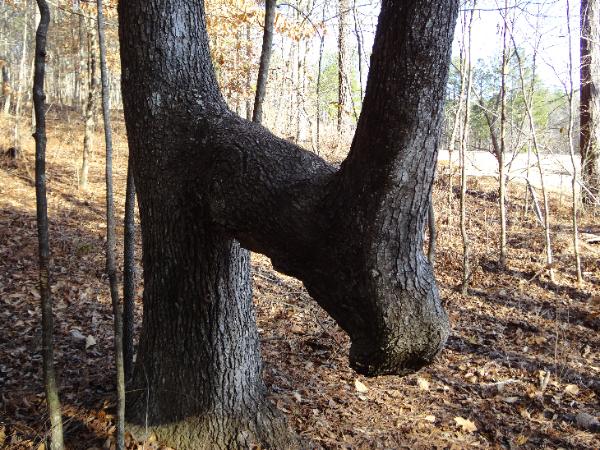
These trees often bend sharply at a low height before curving upward again toward the sky. At first glance, such shapes may appear to be the result of storm damage, heavy snow, lightning strikes, or natural growth patterns.
In some cases, that explanation is correct. However, historians, researchers, and cultural preservation groups have documented examples of trees that appear to have been intentionally shaped by Native American communities many generations ago.
Before European settlement dramatically altered the landscape of North America, Native American tribes developed sophisticated systems for navigating large territories.
These systems were rooted in close observation of nature — the movement of the sun and stars, the flow of rivers, the contours of hills, and seasonal changes in vegetation.
Oral tradition played an essential role. Knowledge of routes, water sources, hunting grounds, and safe passages was passed down carefully from one generation to the next.
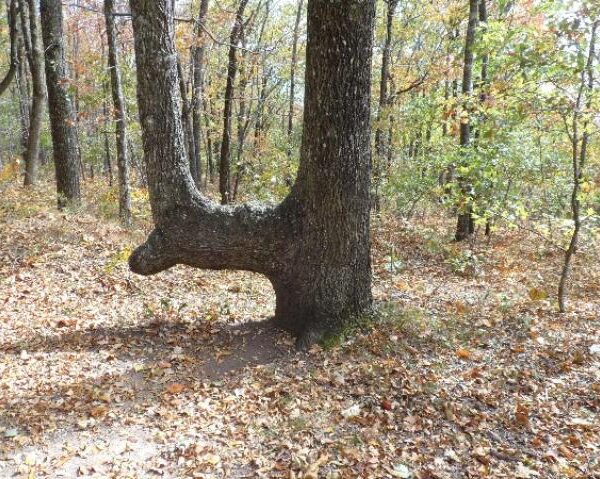
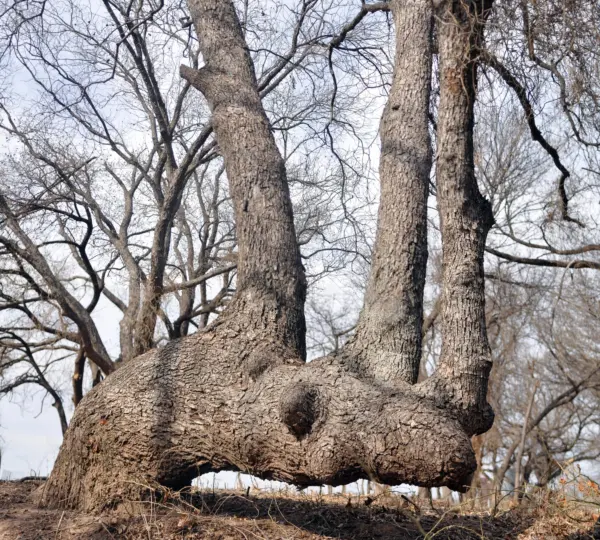
In certain regions, young saplings were deliberately bent while they were still flexible. The trees were shaped in a way that created a long, horizontal trunk section before the tree resumed vertical growth.
Over time, as the tree matured, it retained the trained shape. These modified trees served as durable, living markers in the landscape.
Unlike wooden signposts or carved markers that could decay quickly, living trees continued to grow and survive for decades — sometimes centuries.
According to researchers and organizations such as Mountain Stewards, which has documented and mapped hundreds of potential trail trees, these trees often pointed toward important destinations.
These could include freshwater springs, river crossings, mountain gaps, trading routes, or seasonal gathering areas.
In heavily forested environments where visibility was limited and landmarks could be difficult to distinguish, a deliberately shaped tree could serve as a critical guide.
It is important to note that not every bent tree is a trail tree. Nature itself produces many unusual growth forms.
Trees may bend because of prevailing winds, competition for sunlight, soil instability, or physical damage early in their development.
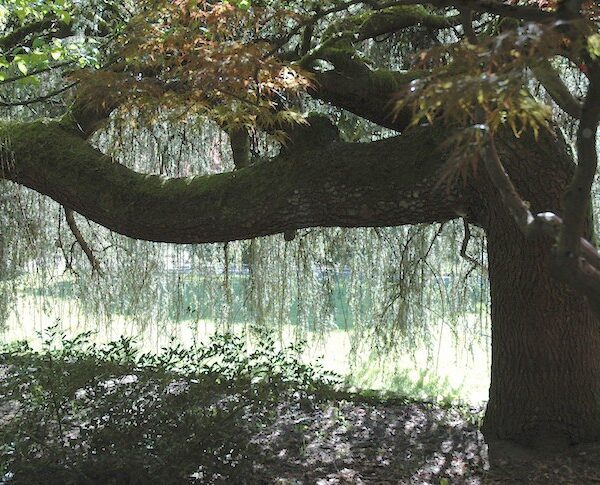
For this reason, researchers emphasize caution when identifying potential marker trees. Careful study, historical context, and pattern analysis are necessary before drawing conclusions.
Still, certain characteristics have been observed repeatedly in trees believed to be intentionally shaped. One commonly described feature is a pronounced horizontal bend occurring a few feet above ground level, followed by a gradual upward curve.
In some cases, a small protrusion or knot appears near the bend. This feature is sometimes described as a “nose.”
Oral accounts suggest that pegs or small branches may have been inserted into the trunk to help secure the bend while the tree grew around it, though physical evidence varies from tree to tree.
Another indicator sometimes mentioned is the presence of scarring on the upper portion of the bend. Such marks could theoretically result from bindings, straps, or ties used to hold the sapling in position.
However, natural scarring can also occur due to insects, disease, or environmental stress. For this reason, experts recommend evaluating multiple factors together — including age, surrounding terrain, proximity to historic travel routes, and local tribal history — rather than relying on one feature alone.
Many trees identified as possible trail trees are estimated to be between 150 and 200 years old, though some may be older.
Age estimation typically involves measuring trunk diameter and applying species-specific growth rate calculations.
In some cases, fallen specimens have been examined through dendrochronology, the scientific study of tree rings, to estimate their age more precisely.
The cultural importance of these trees extends beyond navigation. They represent a profound understanding of ecology and long-term planning.
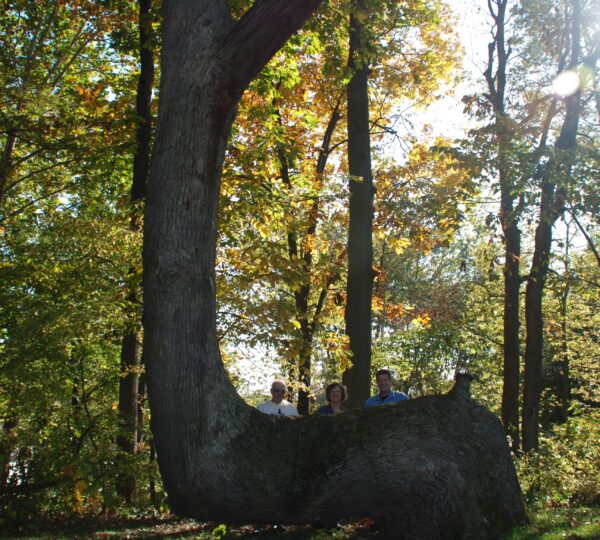
Shaping a sapling required patience and foresight. The individual bending the tree may not have personally benefited from its full development.
Instead, the tree would guide future generations. This reflects a broader Indigenous worldview centered on continuity, stewardship, and intergenerational responsibility.
As European settlers expanded westward, many Indigenous trails were adopted and later transformed into wagon roads, highways, and rail lines.
Some historians believe that certain early American roads may have followed pre-existing Native American pathways, which themselves may have been marked in part by shaped trees and other natural indicators.
However, large-scale land clearing, logging, agriculture, and urban development dramatically altered the landscape. Countless trees were cut down, and much traditional ecological knowledge was disrupted or lost.
Today, the survival of possible trail trees faces ongoing challenges. Population growth and land development continue to reshape forests.
Road construction, housing expansion, and commercial projects can remove trees before their historical significance is recognized. In some cases, property owners may not realize that a strangely shaped tree could have cultural value.
This is one reason preservation efforts have gained attention. Organizations, historians, and volunteers work to document locations, photograph specimens, and gather oral histories connected to particular sites.
The database created by Mountain Stewards, for example, includes geolocation data, images, and descriptive notes for trees that meet specific criteria.
While not every documented tree can be definitively proven to be a Native American marker, systematic documentation helps researchers study patterns and preserve what remains.
Public education plays a key role in preservation. When people understand that certain landscape features may carry cultural and historical meaning, they are more likely to approach them with care.
Schools, museums, and community groups increasingly highlight Indigenous contributions to land stewardship and navigation techniques.
This broader awareness fosters respect for the ingenuity and resilience of Native American communities.
It is also important to approach the subject with balance and accuracy. Some scholars caution against over-attribution. In recent decades, public interest in “Indian marker trees” has grown, and in some cases, claims have outpaced evidence.
Professional historians and archaeologists stress the importance of verifying local tribal connections and avoiding generalized assumptions.
Responsible interpretation requires collaboration with Native American tribes, whose perspectives and oral traditions are essential to understanding these landscapes.
Despite academic debate about individual specimens, there is broad agreement that Indigenous peoples across North America used sophisticated environmental markers.
Whether through shaped trees, rock cairns, controlled burns, or other land-based signals, Native communities developed systems that allowed them to navigate and manage vast territories effectively.
These systems were part of a larger body of ecological knowledge refined over thousands of years.
For modern observers, encountering a bent tree in the woods can be a powerful experience. In a world dominated by digital screens and satellite imagery, such a tree stands as a living reminder of a time when navigation depended on memory, observation, and collaboration with the natural environment.
The tree’s unusual form invites curiosity. Why does it bend so deliberately? What story does it hold? Who may have shaped it, and for what purpose?
When walking through wooded areas, it is wise to observe respectfully. Avoid climbing on or damaging unusual trees.
If you believe you have found a potential trail tree, consider researching local history or contacting preservation groups for guidance. Documentation, photographs, and careful study are preferable to disturbance.
In Georgia and other southeastern states, several documented examples have drawn public interest. Educational videos and local historical programs sometimes feature these trees to illustrate how Indigenous knowledge shaped early travel routes.
Seeing an example in person often makes the concept more tangible. A simple bend in a trunk becomes more than a curiosity — it becomes a symbol of continuity.
The broader lesson extends beyond navigation. Trail trees, whether definitively verified or thoughtfully studied as possibilities, encourage reflection on how humans relate to the land.
Modern infrastructure often prioritizes speed and efficiency. Indigenous navigation emphasized harmony, adaptation, and sustainability.
Rather than imposing rigid structures onto the landscape, Native communities worked with existing ecosystems.
This perspective has renewed relevance today. Environmental challenges such as deforestation, habitat loss, and climate change highlight the need for sustainable practices.
Learning from historical land stewardship approaches can inform modern conservation efforts. Respecting culturally significant trees aligns with broader goals of biodiversity protection and historical preservation.
In addition, these trees offer an opportunity for meaningful dialogue about Indigenous history in the United States.
For many years, Native American contributions were underrepresented in mainstream historical narratives. Recognizing trail trees as part of a larger system of Indigenous innovation helps correct that imbalance.
It acknowledges that advanced knowledge systems existed long before modern technology.
Ultimately, the story of trail trees is not only about the past. It is about awareness in the present and responsibility for the future. Each surviving bent tree is a living archive.
Its growth rings record years of changing seasons. Its shape reflects human intention layered onto natural development. Its continued existence depends on whether current generations choose to protect it.
The next time you walk through a forest and notice a tree bending sharply before rising again toward the sky, pause for a moment. Look carefully at its form, its surroundings, and its age.
Consider the possibility that it may represent more than an accident of wind or weather. It may be part of a tradition rooted in deep environmental knowledge and cultural continuity.
Technology has transformed navigation in extraordinary ways. GPS systems provide instant directions, traffic updates, and global connectivity.
Yet long before satellites guided drivers across highways, people relied on memory, stars, rivers, and living trees. That legacy remains quietly present in certain corners of the American landscape.
Preserving these trees means preserving stories — stories of survival, cooperation, and understanding the land not as an obstacle, but as a partner.
With continued research, respectful dialogue, and community engagement, these living landmarks can continue to educate and inspire.
In a fast-moving digital age, trail trees remind us that wisdom does not always come from advanced machinery. Sometimes it grows slowly, ring by ring, shaped by human hands and sustained by nature itself.

