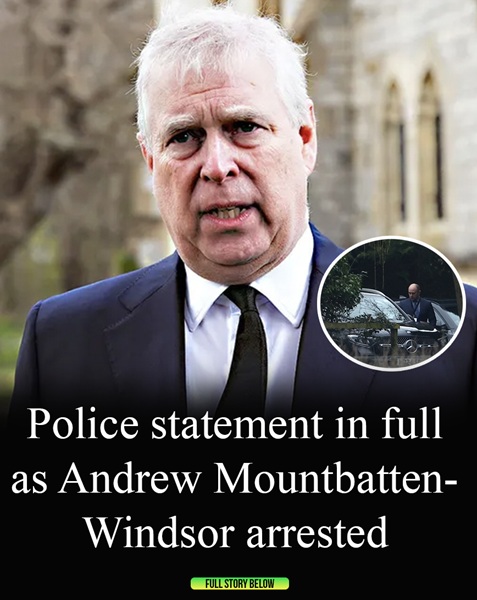
On the morning of Thursday, February 19, 2026, Andrew Mountbatten‑Windsor — formerly known as Prince Andrew — was arrested by UK police on suspicion of misconduct in public office.
The arrest took place at his home at Wood Farm on the Sandringham Estate in Norfolk, just hours after he turned 66 years old.
This extraordinary development has triggered widespread public, political, and legal attention in the United Kingdom and beyond.
Mountbatten‑Windsor, once a senior member of the British royal family and younger brother of King Charles III, has consistently denied any wrongdoing.
The current investigation, however, focuses on allegations that arose from newly disclosed files connected to the late financier Jeffrey Epstein, which were released in early 2026.
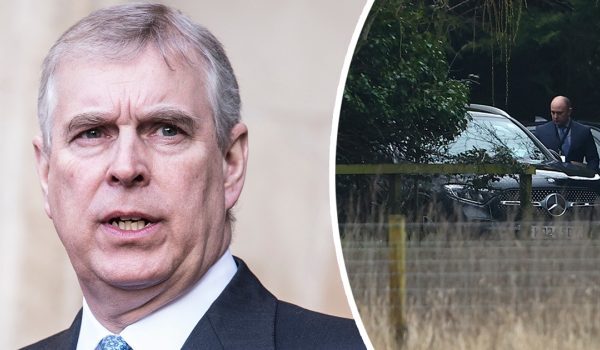
While police have not yet charged him with any offense, the arrest marked a pivotal moment in the scrutiny of his actions during his decades of public service — and represented a stunning chapter in the modern history of the British monarchy.
The Circumstances of the Arrest
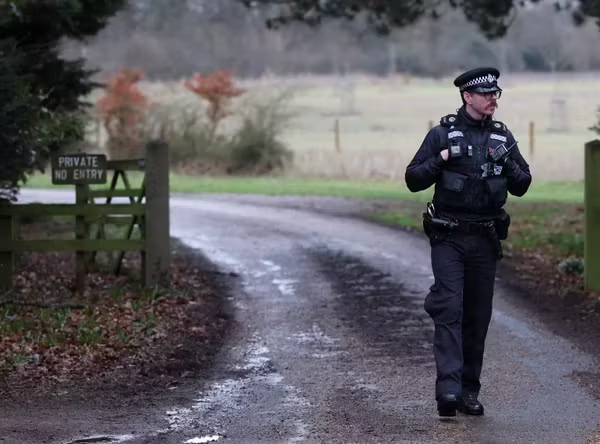
In the early hours of February 19, multiple unmarked Thames Valley Police vehicles were seen arriving at Wood Farm, a small residence on the Sandringham estate where Mountbatten‑Windsor had been living.
Officers conducted searches and then announced that a man in his sixties had been detained on suspicion of misconduct in public office.
Under UK law, police are generally required not to name an arrested individual publicly until formal charges are brought — even in high‑profile cases — which is why the official statement did not initially identify Mountbatten‑Windsor by name.
However, multiple reputable news outlets and law enforcement sources have confirmed that the person arrested is the 66‑year‑old former prince.
Following his arrest, Mountbatten‑Windsor was taken into police custody at Aylsham Police Investigation Centre in Norfolk, where he was questioned for roughly 11 to 12 hours before being released under investigation later that evening.
This means he has not been charged, but remains part of an active investigation.
Thames Valley Police: Official Statement
The police force responsible for the investigation — Thames Valley Police — issued a formal statement shortly after the arrest.
The full statement emphasized the seriousness of the inquiry as well as legal restrictions on public reporting at this stage of the case: “As part of the investigation, we have today (19/2) arrested a man in his sixties from Norfolk on suspicion of misconduct in public office and are carrying out searches at addresses in Berkshire and Norfolk.
The man remains in police custody at this time. We will not be naming the arrested man, as per national guidance. Please also remember that this case is now active so care should be taken with any publication to avoid being in contempt of court.

Assistant Chief Constable Oliver Wright said: ‘Following a thorough assessment, we have now opened an investigation into this allegation of misconduct in public office.
‘It is important that we protect the integrity and objectivity of our investigation as we work with our partners to investigate this alleged offence.
‘We understand the significant public interest in this case, and we will provide updates at the appropriate time.’”
What Is “Misconduct in Public Office”?
The offence misconduct in public office is a serious criminal allegation under UK law. It applies when someone holding a public position abuses their powers, duties, or access to confidential information without lawful justification. While the specific legal elements can be complex, the charge reflects an alleged breach of public trust.
In some cases, this charge has carried a maximum sentence of life imprisonment — reflecting the gravity with which UK law regards abuse of public responsibilities.
Importantly, being arrested on suspicion of this offence does not imply guilt. Anyone arrested in the UK is considered innocent until proven guilty in a court of law.
Why Is This Investigation Happening?
The investigation traces back to a major release of documents in early 2026 involving the late sex offender Jeffrey Epstein.
Among millions of pages of files disclosed by the United States Department of Justice were emails and correspondence that raised questions about Mountbatten‑Windsor’s conduct while he served as a UK trade envoy in the early 2010s.
During that period, from approximately 2001 to 2011, Andrew Mountbatten‑Windsor represented Britain internationally in trade and investment roles, attending official visits to countries including Singapore, Hong Kong, and Vietnam.
Trade envoys are expected to handle commercial and political information with confidentiality, particularly when it relates to diplomatic strategy or sensitive negotiations.
Police are examining whether Mountbatten‑Windsor shared confidential government materials — including trade reports, internal correspondence, or other sensitive information — with Epstein or related parties.
These allegations stem from the recently released files, which have been the subject of intense scrutiny by journalists and investigators worldwide.
Searches at Multiple Properties
In addition to the arrest at Wood Farm, police conducted searches at other properties linked to Mountbatten‑Windsor, including his former residence at Royal Lodge in Windsor Great Park, Berkshire.
The searches were part of efforts to locate potentially relevant evidence such as computers, files, emails, and other documentation.
The searches in Norfolk reportedly concluded soon after the arrest, but investigations at the Berkshire property continued as of the latest updates.
Response from Buckingham Palace and King Charles III
Following the arrest, King Charles III issued a written statement acknowledging the seriousness of the situation and expressing support for the legal process: “I have learned with the deepest concern the news about Andrew Mountbatten‑Windsor and suspicion of misconduct in public office.
What now follows is the full, fair and proper process by which this issue is investigated in the appropriate manner and by the appropriate authorities.
In this, they have our full and wholehearted support and co‑operation. Let me state clearly: the law must take its course. As this process continues, it would not be right for me to comment further on this matter. Meanwhile, my family and I will continue in our duty and service to you all.”
Buckingham Palace also reportedly indicated that it would not oppose any legislative action to formally remove Mountbatten‑Windsor from the line of succession if the investigation justified such a step — although this would require broader political and constitutional approval.
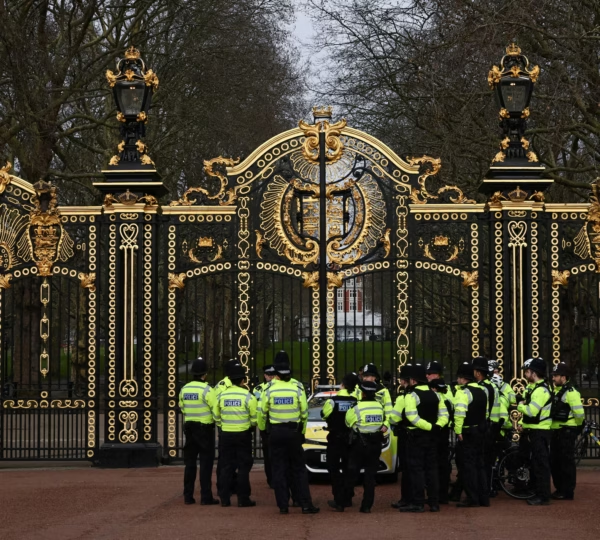
Public and Political Reaction
The arrest has generated significant public and political discourse:
-
Some UK political figures have called for legislative changes to remove Mountbatten‑Windsor from the royal line of succession permanently, arguing that continued proximity to the throne is incompatible with ongoing legal scrutiny.
-
Members of Epstein’s victims’ families have expressed that the arrest underscores that no one is above the law, even high‑profile figures, while also urging fairness and due process.
-
Royal commentators and historians have described the events as one of the most serious crises involving the British royal family in modern memory, particularly given the historic nature of arresting a senior royal figure.
-
Some members of the public and commentators on social media have debated the implications of the allegations, the extent of police access to internal royal documentation, and questions surrounding the scope of the investigation. (No new evidence from these discussions has been independently verified and should be understood as public commentary rather than confirmed fact.)
Legal Status and Next Steps
As of the latest official information:
-
Andrew Mountbatten‑Windsor has been released under investigation, which means he is not currently in police custody but remains subject to ongoing police inquiries.
-
He has not been formally charged with any offence.
-
The investigation into alleged misconduct continues, with search activity and evidence review ongoing.
-
Police are expected to consult with the Crown Prosecution Service (CPS), which will determine whether sufficient evidence exists to bring formal charges.
Under UK legal practice, suspects released under investigation have their movement and activities monitored, and prosecutors may present evidence to court at a later date if charges are deemed appropriate.
How This Fits Into the Broader Epstein Files Context
The arrest comes amid renewed examination of the Epstein case, which over the past decade has implicated many prominent individuals worldwide.
The UK investigation differs from earlier civil and criminal cases in other countries, as it focuses specifically on possible breaches of public office conduct — not on sexual offences related to Epstein’s network.
Mountbatten‑Windsor previously faced intense scrutiny over his relationship with Epstein and reached a large settlement in a 2022 civil case in the United States. He denied liability but agreed to the settlement to resolve the matter.
Those historical issues, while publicly known, are not themselves the basis for the current UK police investigation. The ongoing probe is strictly centered on the alleged sharing of confidential information, not on past civil litigation.
Historical Significance
If the allegations are officially pursued through prosecution, this would mark an unprecedented moment in modern British history. According to historical records:
- The last senior royal figure arrested in England was Charles I in 1647, during the English Civil War.
- No other sibling of a reigning monarch has been taken into custody on criminal suspicion since the reign of Elizabeth I in the 16th century.
These facts highlight how significant and unusual the current case is within the context of constitutional and royal history.
Conclusion
The arrest of Andrew Mountbatten‑Windsor on suspicion of misconduct in public office represents one of the most consequential legal and constitutional developments involving the British royal family in generations.
While he has not been convicted of any crime, the formal police investigation — its serious allegations, historic implications, and ongoing scrutiny by prosecutors and the public — has placed a former senior royal under intense legal examination.
British law and the legal process will now determine how the case proceeds. For his part, Mountbatten‑Windsor has denied wrongdoing, and the investigation is continuing under UK police and prosecutorial oversight.
