

I’ve had my share of uncomfortable public moments since becoming a wheelchair user. Most are small things — awkward stares, well-meaning but intrusive questions.
Strangers assuming they need to push me without asking. You learn to manage those situations with patience. But what happened at Walmart that afternoon was different.
It wasn’t just awkward. It was aggressive, humiliating, and strangely revealing about how little some people understand invisible disability. It started as an ordinary weekday errand. I needed groceries, household essentials, and a few items from the pharmacy. Nothing unusual.
I drove myself to the store, parked in the designated accessible parking space, lowered the ramp from my vehicle, and wheeled inside.

For context: I’m paralyzed from the waist down. I use a wheelchair full time. While I may not “look” disabled, I cannot stand or walk. My feet are strapped securely onto the footrests of my chair.
The store was moderately busy. Families with children. Retirees browsing slowly. A few teenagers laughing too loudly near electronics. It was an ordinary cross-section of everyday life.
I navigated the aisles comfortably, maneuvering tight corners, reaching what I could, and politely asking for help if necessary. Most interactions that day were routine — even pleasant. Then, without warning, everything shifted.
I had just turned into the main aisle near the seasonal section when a man abruptly stepped directly in front of my wheelchair. He didn’t accidentally block my path.
He planted himself there. He looked agitated — jaw clenched, face tight. His wife stood slightly behind him, hands clasped together, eyes lowered. Before I could ask him to move, he spoke: “You need to give my wife that wheelchair.”
For a moment, I genuinely thought I had misheard him. “I’m sorry?” I replied calmly. “You’re young. You look perfectly healthy,” he continued, raising his voice slightly.
“My wife has been on her feet all day. She needs it more than you.” I blinked. I had encountered ignorance before, but this was something else entirely.

“I actually need this wheelchair to move around,” I explained. I expected that statement to end the interaction. It didn’t.
Instead of backing down, he stepped closer. “No, you don’t,” he snapped. “You’re sitting there just fine. She’s exhausted. You could stand for a while.” His wife shifted uncomfortably but remained silent.
I felt a familiar knot form in my stomach — the tension that comes when someone questions your disability because it doesn’t fit their narrow expectations. “I can’t stand. I’m paralyzed from the waist down,” I repeated.
He scoffed. “That’s what everyone says.” The dismissal hit harder than the accusation. Nearby shoppers had started to slow down. Some pretended to browse while clearly listening. Others openly stared.
I kept my voice steady. “This is my mobility device. I cannot give it away.” He raised his voice further. “So she just has to suffer? That’s fair to you?”
Just as my patience began to thin, a middle-aged Walmart employee approached. He wore a blue vest and had the calm demeanor of someone used to diffusing tense situations.
“Sir,” he asked the man, “is there a problem here?” The man gestured dramatically. “Yes! This guy is refusing to give my wife his wheelchair. She’s been standing all day!”
The employee turned to me respectfully. “Is that true?” I took a slow breath. “No. I’m paralyzed from the waist down. I cannot walk.” The man rolled his eyes.

“Sure you are.” The employee crouched slightly — not in doubt, but to observe carefully. From that angle, he could clearly see the medical braces beneath my jeans and the foot straps. He stood back up, firm. “This customer clearly needs his wheelchair. Your request is inappropriate.”
The man’s face flushed red. “So what? My wife just has to suffer?” His wife finally spoke, voice barely audible. “It’s okay… we can go.”
There was no anger in her tone, only embarrassment. For a split second, our eyes met. There was something in her expression — not hostility, not pity — but fatigue. Not physical fatigue, but emotional.
The man wasn’t finished. He started shouting about discrimination, “hardworking people,” and life being unfair. I sat there, physically unable to stand, being accused of selfishness for not surrendering the device that allowed me basic mobility. It was overwhelming.
Two more employees arrived. Then a store manager — calm, authoritative. She asked a single question: “Sir, are you demanding that a disabled customer give up his personal mobility device?”
The phrasing cut through the chaos. The man hesitated. “Well… when you put it like that—”
“Then I’m going to have to ask you to leave,” she said evenly. “This behavior violates our customer conduct policy.” That was the turning point.
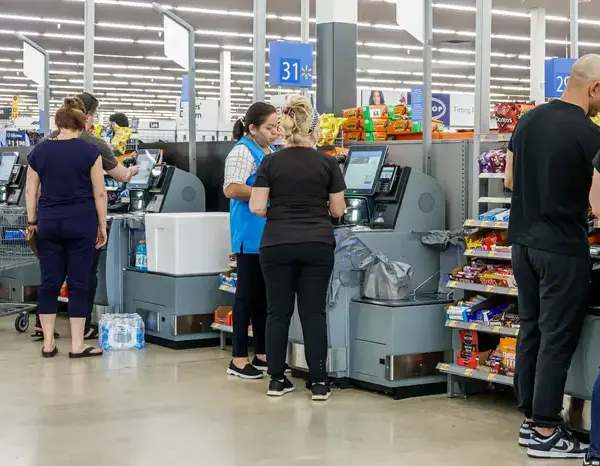
He exploded — accusations, profanity, claims of unfair treatment. Security escorted him toward the exit. His wife followed, slumped and embarrassed, whispering softly to me, “I’m sorry.” Then she was gone.
The aisle fell quiet. Shoppers murmured, expressing sympathy. The manager personally apologized and offered assistance with my shopping.
I declined, needing only a moment to process. It wasn’t the yelling that stayed with me, but the assumption — that my disability must look a certain way, and that someone who appears “healthy” might not truly need help.
Invisible disabilities often invite scrutiny. People feel entitled to judge what they cannot see, and sometimes entitled to challenge it.
Mobility devices are not luxuries. My wheelchair is not a seat. It is my legs. Public spaces are shared spaces, and dignity is not optional.
As I loaded my groceries into my vehicle later that afternoon, I thought about the wife. The way she stood slightly behind him, whispered softly, and finally apologized.
I don’t know their story, but entitlement often masks deeper frustrations or insecurities. That doesn’t excuse behavior, but it explains why moments like this escalate so quickly.
The experience reminded me that all it takes is empathy. A simple question, a pause, or respect could have prevented it. For every loud voice fueled by entitlement, there are multiple grounded voices guided by fairness and respect — like the employees who intervened.
That Walmart encounter is unforgettable. Not for drama, but for what it revealed about assumptions, ignorance, and the quiet decency of those who choose kindness.

