
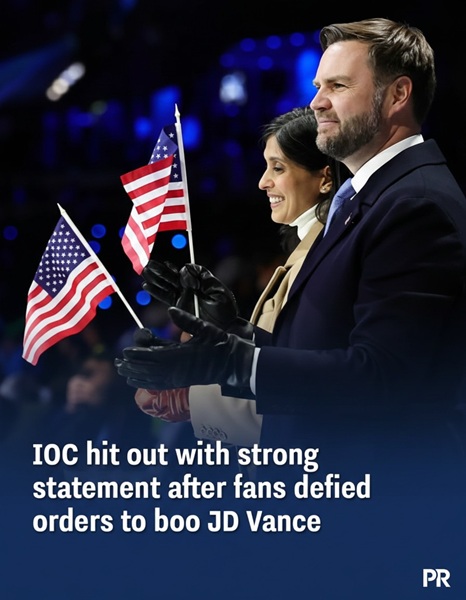
The International Olympic Committee moved swiftly to address public reaction after U.S. Vice President JD Vance was loudly booed during the opening ceremony of the 2026 Winter Olympics.
An incident that briefly shifted attention away from sport and toward the complex relationship between global politics and international competition.
The moment unfolded at San Siro Stadium in Milan, where millions of viewers around the world were watching a ceremony carefully designed to celebrate unity, athletic excellence, and international cooperation.
The opening night of the Olympic Games is traditionally a symbol of shared values—discipline, perseverance, and mutual respect among nations. Yet, for a brief but noticeable moment, those ideals were tested by the realities of global political sentiment.
What was intended to be a universally uplifting celebration instead reflected deeper political tensions that exist far beyond the boundaries of the Olympic movement.
A Ceremony Framed by Grandeur and Symbolism
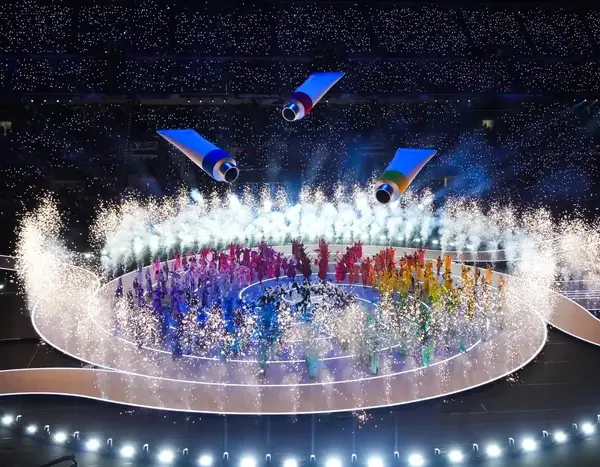
The opening ceremony itself was a meticulously choreographed display of artistry and scale. High-profile performances by internationally recognized artists Andrea Bocelli and Mariah Carey set a tone of elegance, emotion, and cultural significance.
Their appearances were meant to underline the unifying power of music and shared human expression—an enduring theme of Olympic ceremonies.
With ninety-two nations participating, the evening emphasized the diversity and global reach of the Winter Games.
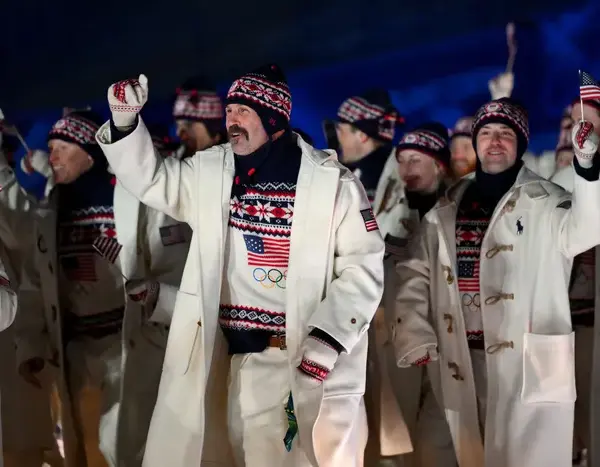
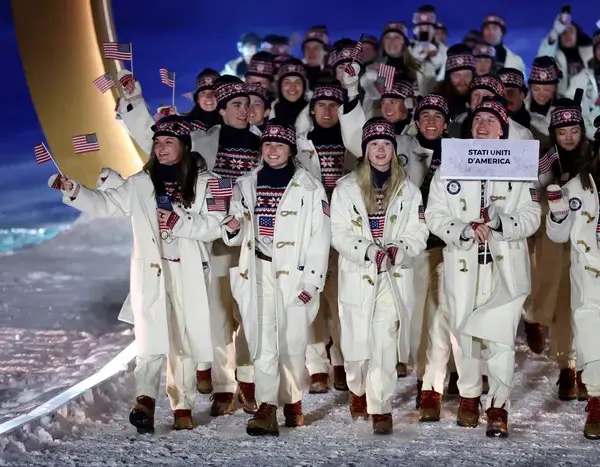
Delegations from across the world entered the stadium in a carefully ordered procession, each greeted with applause that reflected the international spirit of the event. The atmosphere, at least initially, aligned with the Olympic ideal: celebration without borders.
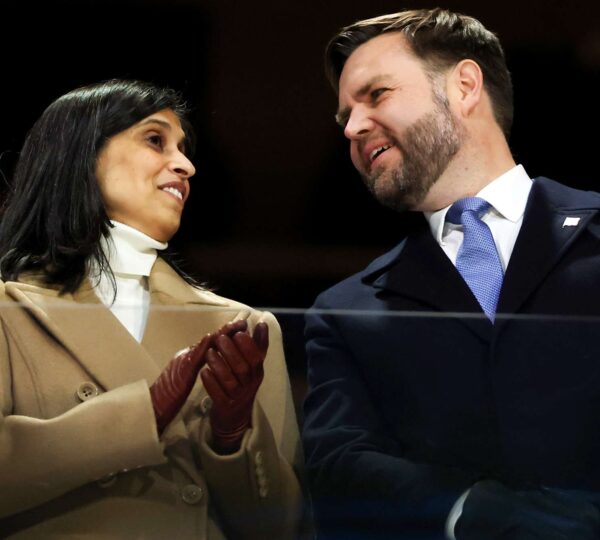
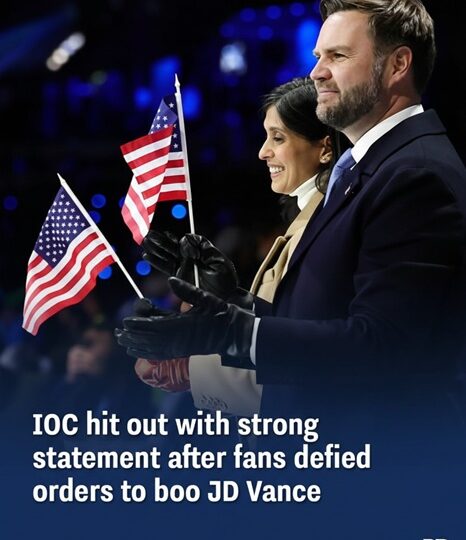
As the United States delegation entered the stadium, it drew heightened attention. Leading the group was Vice President JD Vance, representing the U.S. government at the ceremony.
When cameras focused on him, sections of the crowd responded with sustained boos—an audible reaction that contrasted sharply with the celebratory mood established earlier in the evening.
The moment was brief, but unmistakable. For viewers at home and officials within the stadium, it stood out as a reminder that even the most carefully staged international events remain deeply connected to global realities.
A Charged Political Atmosphere Beyond the Stadium
The reaction did not occur in isolation. Earlier that day, large public demonstrations had taken place in Milan related to U.S. immigration policies.
While former President Donald Trump was not present at the Games, the protests reflected broader concerns and frustrations that extended beyond any single political figure.
These demonstrations appeared to influence the broader atmosphere surrounding the ceremony.
Although the Olympics are intended to rise above political divisions, they do not exist outside the world in which they are held. Global events, public opinion, and political discourse often follow spectators into the stadium, regardless of official intentions.
The booing of Vice President Vance was widely interpreted as an expression of political dissatisfaction rather than a personal attack. Still, its visibility during a ceremony dedicated to unity raised questions about the limits of political expression in Olympic spaces.
Calls for Respect and Restraint from Olympic Leadership
In the days leading up to the opening ceremony, IOC President Kirsty Coventry had publicly urged athletes, officials, and spectators to treat the Games as a moment of mutual respect.
She emphasized that the opening ceremony should focus on the achievements of athletes who had spent years preparing for this opportunity.
Her message reflected a long-standing Olympic principle: that sport should provide a neutral platform where nations can compete without hostility or political confrontation.
Following the incident, IOC spokesperson Mark Adams addressed the situation in public remarks. He reaffirmed the organization’s commitment to constructive engagement with U.S. leadership, particularly in light of the upcoming Los Angeles Summer Games.
According to Adams, cooperation between the IOC and host nations is essential for the success and continuity of the Olympic movement.
He framed this engagement not as political alignment, but as institutional responsibility—ensuring that future Games can be organized effectively and inclusively.
Adams also reiterated the IOC’s broader stance on crowd behavior, referencing past incidents involving Israeli athletes and other delegations.
He stressed that competitors and official representatives should never be targeted for the actions of governments. “The Olympics,” he stated, “are built on respect, fairness, and appreciation of excellence—regardless of nationality.”
Athletes Caught Between Politics and Purpose
While the reaction was directed at a political figure, the incident highlighted a recurring tension in global sport. Athletes dedicate years—often decades—to training, sacrifice, and discipline in pursuit of excellence.
Their presence at the Olympics represents personal achievement and national pride, not political ideology.
Yet on international stages of this magnitude, athletes and officials alike often become symbolic carriers of political meaning they did not choose.
Public frustration, global grievances, and unresolved political debates can be projected onto individuals whose primary role is representation through sport, not governance.
Moments like this reveal how fragile the boundary between sport and politics can be. Even when organizers work diligently to maintain neutrality, the emotions and opinions of spectators can surface in unpredictable ways.
The Olympics as a Mirror of the World
The Olympic Games do not exist in a vacuum. They are shaped by the world in which they occur.
They reflect its conflicts.
They echo its frustrations.
They carry its hopes.
Every host city, every delegation, and every spectator brings their own context into the arena.
While the Olympic Charter emphasizes neutrality and unity, the Games inevitably mirror the broader international environment—both its progress and its divisions.
At the same time, the Olympics offer something increasingly rare in modern global life: a shared space where rivalry can coexist with respect, and where difference does not automatically lead to dehumanization.
Preserving that space requires restraint—from institutions, political leaders, and spectators alike. It requires recognizing that while political expression is a reality of democratic societies, the Olympic stage serves a different purpose.
Protecting the Integrity of the Olympic Experience
The IOC’s response to the reaction toward Vice President Vance emphasized its long-standing commitment to dignity, neutrality, and the protection of athletes and participants.
While political tensions briefly surfaced during the opening ceremony, the organization made clear that the heart of the Olympic movement lies in unity through sport.
The emphasis was not on suppressing public sentiment, but on maintaining an environment where athletic achievement remains the central focus.
The Games, according to IOC leadership, should not become a platform for political confrontation that risks overshadowing years of dedication by competitors.
This position reflects lessons learned from previous Olympic controversies, where political disputes threatened to dominate headlines at the expense of athletic excellence.
A Moment of Reflection for a Divided World
In a global climate marked by polarization and competing narratives, moments like this serve as reminders of the challenges facing international cooperation.
True unity is not achieved by pretending differences do not exist, but by choosing—repeatedly—to prioritize respect over reaction.
The Olympic Games remain one of the few global events capable of bringing nations together under shared rules and shared values.
Their power lies not in eliminating disagreement, but in demonstrating that competition and coexistence are possible at the same time.
As the 2026 Winter Olympics continued beyond opening night, the focus returned to athletes, performances, and the spirit of competition.
The brief controversy did not define the Games—but it did underline the importance of safeguarding the Olympic ideal in an increasingly complex world.
In the end, the message reaffirmed by the IOC was clear: athletic excellence should speak louder than politics. And when it does, it offers the world a rare glimpse of what cooperation, respect, and shared humanity can still look like.

