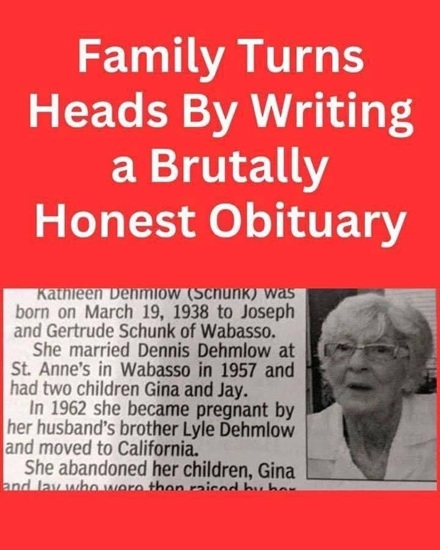
Obituaries are traditionally written as final tributes—measured, respectful summaries of a life that has ended. They often focus on dates, relationships, and accomplishments, offering comfort to those left behind.
Yet in rare cases, an obituary does something entirely different. Instead of closure, it opens a wound. Instead of praise, it tells a painful truth.
One such obituary, published in 2018 in Minnesota, stunned readers around the world and ignited a broader conversation about grief, family trauma, and who gets to control the final narrative of a life.
At first glance, the obituary of Kathleen Dehmlow appeared ordinary. It followed the familiar structure readers expect: a brief account of her birth, family, marriage, and passing.
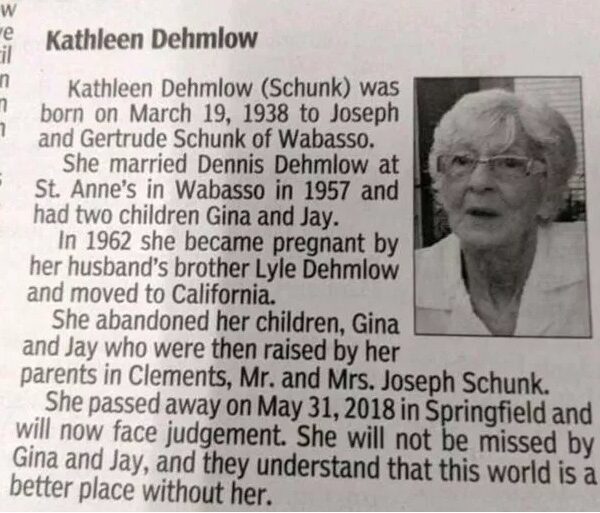
But as readers reached the final paragraphs, the tone shifted sharply. What followed was not remembrance, but reckoning.
Within days, the obituary had gone viral, been removed from its original publication, and sparked global debate over whether honesty—even brutal honesty—belongs in death notices.
A Conventional Beginning
Kathleen Dehmlow’s obituary was published in the Redwood Falls Gazette, a local Minnesota newspaper. Like countless obituaries before it, the notice began with basic biographical details.
Kathleen was born in Springfield, Minnesota, to her parents, Gertrude and Joseph. She later married in Minnesota in 1957 and had two children, Gina and Jay. She passed away on March 31, 2018, at the age of 80.
Up to this point, there was nothing unusual. Readers scanning the obituary would have recognized the familiar rhythm—names, dates, relationships—written in the restrained, factual style typical of death announcements.
Many likely expected the closing lines to mention surviving relatives, funeral arrangements, or expressions of gratitude.
Instead, the obituary took an unexpected and deeply unsettling turn.
A Sudden Shift in Tone
In the final portion of the obituary, the narrative changed dramatically. According to the published text, Kathleen became pregnant by her brother-in-law in 1962.
The obituary stated that she then moved to California and “abandoned” her two children, Gina and Jay, leaving them to be raised by her own parents.
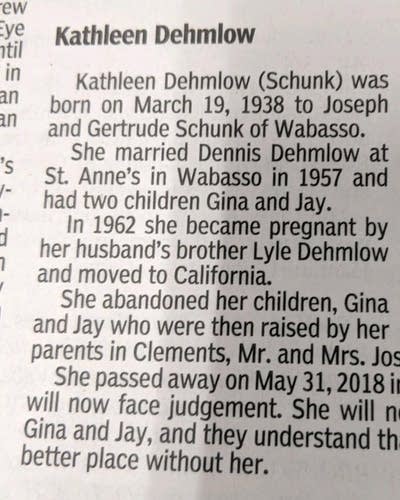
The most striking line came at the end.
“She will not be missed by Gina and Jay,” the obituary concluded, adding that “they understand that this world will be a better place without her.”
The words stood in stark contrast to the conventions of obituary writing. There was no attempt to soften the language, no expressions of forgiveness, and no effort to maintain neutrality. The statement was final, direct, and deeply personal.
Readers reacted immediately.
Public Reaction and Removal
As the obituary circulated online, reactions poured in. Many readers expressed shock at its harshness, while others defended the right of the surviving children to tell their story.
Social media amplified the controversy, turning what had been a local obituary into an international talking point. Within a day, the Redwood Falls Gazette reportedly removed the obituary from its website following public outcry.
The decision reflected the discomfort many felt about the tone of the piece, particularly in a format traditionally reserved for respectful remembrance.
Yet removing the obituary did not end the discussion. Instead, it raised new questions. Why had Gina and Jay chosen to write such a public condemnation? What pain lay behind those words? And who, ultimately, has the right to define a life after death?
A Son Speaks Out
Shortly after the obituary’s removal, Kathleen’s son, Jay Dehmlow, spoke publicly to explain why he and his sister had written it the way they did.
According to reports cited by outlets including the Fraser Coast Chronicle and the Daily Mail, Jay said that no one outside the immediate family could fully understand what he and Gina experienced as children.
Jay explained that after their mother left, contact was rare. He stated that Kathleen seldom visited and that emotional connection was largely absent. He also said she went on to have two other children with her brother-in-law while living in California.
“We didn’t have so much as a card from her,” Jay said, according to reported interviews. He recalled only two visits during his childhood.
During one of those visits, he said, she showed photographs of her life with her other children—playing cards, drinking beers—while Gina and Jay stood in the room, unnoticed.
“It’s like we didn’t exist,” Jay said.
For Jay, the obituary was not written out of cruelty, but out of long-suppressed pain. He described growing up in an environment where family dysfunction was never discussed, where silence replaced acknowledgment, and where emotional wounds were left untreated.
“You can’t believe the dysfunction of the family,” he said. “They’ll never know what we went through, but it helped us to write this. We wanted to finally get the last word.”
The Weight of Silence
One recurring theme in Jay’s explanation was silence. According to him, extended family members were largely unaware of what he and his sister experienced. Difficult topics were avoided. Feelings were not discussed. There was no shared language for grief, abandonment, or anger.
This silence, Jay suggested, compounded the damage. Without validation or acknowledgment, the pain remained unresolved for decades. Writing the obituary became, in his words, a form of release—a way to articulate what had been left unsaid for most of their lives.
For many readers, this aspect of the story resonated deeply. Family estrangement, emotional neglect, and unresolved childhood trauma are more common than public conversations often acknowledge.
The obituary became a focal point for those who felt that traditional expectations around forgiveness and respect sometimes leave no room for survivors to tell their truth.
A Family Divided
Not everyone agreed with Gina and Jay’s decision.
Kathleen’s surviving sister, Judy, spoke to DailyMail.com, calling the obituary “nasty” and saying it had “hurt the family tremendously.” From her perspective, the public nature of the obituary added unnecessary pain and overshadowed other aspects of Kathleen’s life.
Jay responded by reiterating that extended family members did not understand what he and Gina endured. He emphasized that “nobody talked about anything” during their childhood, suggesting that the lack of awareness was itself part of the problem.
This division highlights a difficult reality: families often hold multiple, conflicting versions of the same person. A sister may remember one version, while children remember another entirely. An obituary, however, allows only one narrative to be told.
Ethics and the Purpose of an Obituary
The case reignited debate about what obituaries are meant to be. Are they historical records? Personal tributes? Moral summaries? Or simply announcements of death?
Traditionally, obituaries emphasize positive qualities or maintain a neutral tone out of respect for the deceased and their loved ones. Critics of the Dehmlow obituary argued that it violated these norms and caused unnecessary harm.
Supporters countered that honesty should not be censored simply because it is uncomfortable. They argued that survivors of abandonment or abuse should not be expected to sanitize their experiences for the sake of tradition.
Importantly, the obituary did not encourage harm, use slurs, or contain threats. It expressed emotional judgment, but within the bounds of free expression. The controversy, therefore, was less about legality and more about cultural expectations.
Grief Is Not One-Size-Fits-All
One of the most enduring lessons from this story is that grief does not follow a single path. While some people grieve with fond remembrance, others grieve with anger, sadness, or unresolved questions.
For Gina and Jay, the death of their mother did not bring closure—it reopened wounds. Psychologists often note that estranged children may experience a complex form of grief when a parent dies.
There may be sorrow not only for what was lost, but for what never existed. In such cases, expressions of grief can appear harsh or confusing to outsiders. The obituary can be seen through this lens—not as an attack, but as an articulation of long-suppressed emotion.
A Story That Resonated Worldwide
The global attention this obituary received suggests that it touched on something universal. Many people recognized their own family dynamics in the story: unspoken pain, unresolved resentment, and the tension between public appearance and private reality.
While opinions remain divided, few deny that the obituary forced readers to confront uncomfortable truths about family relationships and the limits of forgiveness. It challenged the idea that death automatically transforms a person’s legacy into something positive.
No Easy Answers
Ultimately, there is no simple way to judge whether the obituary was “right” or “wrong.” It caused pain, but it also gave voice to suffering that had been ignored for decades.
It violated tradition, but it also expanded the conversation about honesty, trauma, and who gets to speak after someone dies. What is clear is that none of us can fully know the pain Gina and Jay experienced when their mother left them behind to begin a new life without them.
Their words, however difficult to read, came from a place shaped by absence, silence, and unresolved grief. In the end, the obituary of Kathleen Dehmlow remains one of the most talked-about death notices in recent history—not because of how she lived, but because of what her children felt compelled to say when her life ended.
It stands as a reminder that every family carries stories unseen, and that sometimes, the most shocking words come not from cruelty, but from pain finally given a voice.
