
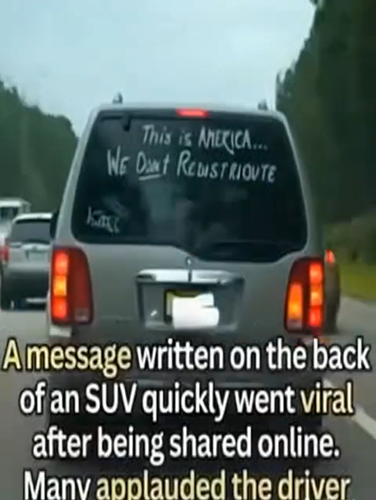
It began with a single photo. A highway in America, an SUV moving through traffic, and a rear window scrawled with a handwritten message: “This is America… we don’t redistribute wealth — we earn it.”
At first glance, it was just a car. But once the photo landed on Reddit, it hit like a punch, reverberating through online communities and social media feeds across the country.
Within hours, thousands of strangers were weighing in. The reactions were polarizing. Some praised the driver as honest, bold, and unapologetic—a person who had simply articulated a core belief in self-reliance and personal responsibility. Others denounced the message as arrogant, callous, or willfully ignorant of the realities that millions of Americans face.
This brief phrase about wealth and “earning it” cracked open a much deeper conversation about the economic, cultural, and moral divides that have been simmering in the United States for decades.
The Photo Goes Viral
The original Reddit post came from a user who captured the SUV on a highway during their commute. The rear window was clearly marked with the hand-written statement in large, dark letters, impossible to miss.
In the photograph, the message seemed to float against the backdrop of an overcast sky, traffic stretching ahead in the lanes beside it, and the SUV’s glossy paint reflecting the afternoon light.
Reddit users immediately flocked to the post. Within hours, the thread grew into thousands of comments. Some users offered context for the sentiment, speculating about the driver’s life—perhaps a self-made entrepreneur, a small business owner, or someone who had overcome personal hardships.
To these supporters, the message wasn’t mean-spirited; it was a celebration of hard work, ambition, and the belief that America rewards initiative and effort.
One commenter wrote: “Finally, someone says it out loud. Nobody owes you a free handout. Work hard, earn your keep, and stop complaining.”
Another added: “This is the attitude that built America. It’s about responsibility and accountability, not whining about inequality.”
These comments reflected a long-standing American narrative of self-reliance and the “bootstrap” ethos—the idea that individuals are responsible for their success and failure, regardless of the circumstances they inherit.
To them, the SUV’s message was a badge of honor, a proud declaration that personal effort and perseverance were the cornerstones of a good life.
The Critics Respond
Yet, the thread also swelled with dissenting voices. For critics, the message on the SUV wasn’t inspiring—it was tone-deaf.
They argued that it oversimplified a complex reality in which millions of Americans face systemic barriers, unequal opportunities, and inherited disadvantages. For them, “earning it” is not always as straightforward as the bumper sticker implied.
One user pointed out: “Not everyone starts at the same line. Some people are born with wealth, connections, and access to education. Others work three jobs and still struggle to make ends meet. Saying we don’t redistribute wealth ignores that reality.”
Another commenter added: “It’s almost cruel to post something like this when so many Americans are living paycheck to paycheck, drowning in medical bills, or struggling with student debt. This isn’t just a difference of opinion—it’s a refusal to acknowledge systemic inequity.”
The Reddit conversation quickly became a microcosm of the broader debate in American society: the tension between individual responsibility and social support, between meritocracy and structural inequality.
Why the Phrase Resonated So Deeply
The viral nature of the photo was not accidental. The message tapped into several cultural and psychological fault lines. First, it resonated with long-held beliefs about the American Dream—the idea that anyone can succeed through hard work and determination.
For generations, this narrative has been a source of pride, motivation, and identity for millions of Americans. At the same time, the statement highlighted the divide between perception and reality.
Critics saw the message as a reflection of privilege, a simplistic view that ignores systemic challenges such as racial inequality, wage stagnation, lack of access to healthcare, and educational disparities.
These factors create vastly different starting points in life, making the concept of “earning it” far more complicated than a bumper sticker can convey.
Additionally, the photograph struck a chord because of its bluntness. It wasn’t a carefully crafted editorial or political essay—it was a raw, handwritten proclamation on a moving vehicle.
This informal, almost confrontational style made the message feel immediate and personal. People didn’t have time to analyze it slowly; they reacted viscerally, with instinctive judgments about the driver, their values, and what the statement meant for society.
The Role of Social Media in Amplifying Debate
The Reddit thread illustrates the power of social media in shaping public discourse. A simple highway sighting—something most commuters might glance at and forget—became a national conversation because it was documented, shared, and discussed online.
Social media amplifies these moments, creating a virtual town square where different perspectives collide. In the case of the SUV photo, Reddit acted as both microscope and mirror. Users scrutinized the driver’s intentions while simultaneously projecting their own beliefs and anxieties onto the message.
Supporters saw affirmation of their worldview; critics saw evidence of societal indifference and inequality. The same image produced entirely different emotional and ideological responses, reflecting how deeply personal values influence interpretation.
Moreover, the viral nature of the post demonstrates how social media can turn ordinary events into cultural touchpoints. A handwritten message on a car suddenly sparks debates about economics, fairness, personal responsibility, and the moral obligations of citizens.
In this sense, the SUV rear window became less about one driver and more about the collective national conversation surrounding wealth, work, and fairness.
Historical Context: The American Debate Over Wealth
The reaction to the SUV photo also echoes historical debates in the United States. For centuries, Americans have wrestled with the question of how wealth should be earned, distributed, and respected.
From the labor movements of the early 20th century to the rise of modern welfare programs, the country has constantly negotiated the balance between personal responsibility and collective support.
In the early days of industrialization, workers fought for fair wages and safer working conditions, asserting that labor deserved compensation beyond what employers were willing to offer voluntarily.
Over time, government programs like Social Security, unemployment insurance, and Medicaid were introduced to provide safety nets. These interventions have been controversial at various points, with critics arguing that they discourage self-reliance and supporters emphasizing the moral and practical necessity of helping those in need.
The SUV’s message can be seen as a modern incarnation of this debate: a reflection of the enduring tension between individual effort and societal support, a microcosm of the American struggle to reconcile freedom, responsibility, and fairness.
Economic Inequality and Public Perception
Economic inequality in the United States has grown significantly over the past few decades, further complicating the “earn it” narrative.
According to the U.S. Census Bureau, income disparities between the top 20% and bottom 20% of households have widened, with wealth increasingly concentrated among a small fraction of the population.
Education, healthcare access, and geographic opportunity also play crucial roles in determining individual outcomes.
Critics of the SUV’s message argue that it fails to recognize these structural factors. While hard work is undoubtedly important, systemic barriers can make success much more challenging for some groups than for others.
For instance, two individuals may work equally hard, but differences in family wealth, neighborhood resources, or racial discrimination can result in vastly different life outcomes. To ignore these realities is to oversimplify a complex, multifaceted issue.
Why Supporters Still Stand Firm
For supporters, however, the SUV’s message resonates because it reaffirms core American ideals. It celebrates self-sufficiency, resilience, and the belief that effort, determination, and perseverance can produce results.
In a culture that often critiques personal ambition, the message is a reminder of a different perspective—one in which individuals are responsible for their own success and should not expect others to redistribute the rewards they have earned.
Supporters also see it as a call to action, a reminder to take ownership of their own lives. In an era of widespread social media commentary and political debate, this type of message can be empowering for those who feel their personal efforts are undervalued or overlooked.
The SUV as a Mirror for Society
Ultimately, the SUV itself is not the story. The vehicle, its driver, and the handwritten note are merely a catalyst. The real narrative is about the way Americans interpret wealth, opportunity, and fairness. The rear window becomes a mirror reflecting deeply held beliefs, fears, and values.
For some, it symbolizes the promise of the American Dream—the idea that hard work leads to reward, no matter the circumstances.
For others, it reveals frustration with a society that prizes individual achievement over collective responsibility, where structural inequities are often overlooked.
The conversation sparked by the SUV is a microcosm of broader debates that continue to divide the country: debates over taxes, social programs, healthcare, education, and the responsibilities of citizens to one another.
Lessons from a Single Photograph
A single, fleeting moment captured on a highway can illuminate much larger cultural truths. The Reddit photo reminds us that symbols—no matter how simple—carry weight, particularly when they touch on fundamental beliefs.
People respond not only to the words themselves but to what the words represent: identity, values, and vision for society. The widespread reactions to the SUV also underscore the importance of empathy in public discourse.
Even when viewpoints clash, the conversation opens the door to understanding the diverse experiences that shape Americans’ attitudes toward work, wealth, and fairness.
Conclusion: A Window Into American Values
In the end, the SUV’s handwritten message on a rear window was less about the car or the driver than it was about a nation grappling with the meaning of success.
“This is America… we don’t redistribute wealth — we earn it” became a Rorschach test for the country, reflecting the sharply divided perspectives on individual effort, systemic barriers, and fairness.
Whether one sees the message as a proud declaration of independence or a dismissive oversimplification of structural inequality, the conversation it sparked illustrates the complexity of American values.
The debate continues, showing that discussions about wealth, opportunity, and personal responsibility are far from settled—and that even a single phrase on a car can ignite a national dialogue.
What began as a casual highway sighting became a lens through which Americans continue to examine their beliefs, assumptions, and the meaning of “earning it” in a society that prizes both freedom and fairness.
And as the conversation unfolds online, on social media, and in living rooms across the country, one thing is clear: sometimes the smallest acts—a handwritten message on a rear window, a photograph shared online—can provoke the largest conversations about who we are as a nation and what we value most.

