
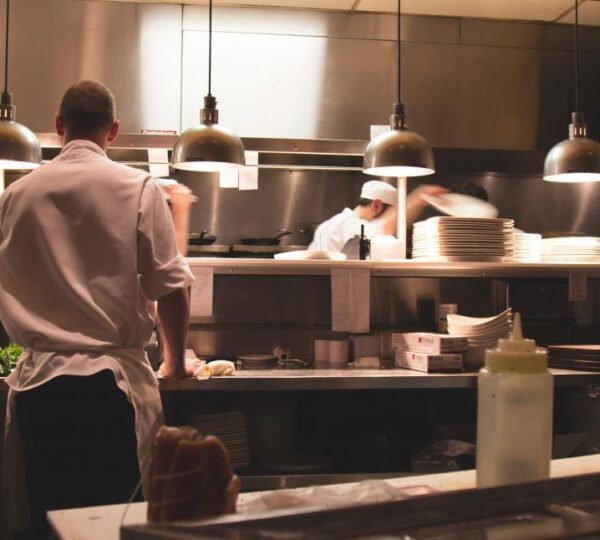
In the humid, high-pressure environment of the “Le Sommet” kitchen, Anna moved like a ghost, unseen yet indispensable. The air was thick with the mingling aromas of caramelizing onions, sizzling garlic.
And seared scallops, which, to the untrained eye, might have seemed chaotic. But for Anna, it was a symphony, every hiss and clatter a note in a composition she had learned to conduct with precision.
Her hands bore the evidence of years in the kitchen: calluses, faint scars from steam burns, and the permanent etching of a life spent bending over knives and stoves. Her hair, dark and unyielding, was tucked into a tight cap, a small concession to the rules of hygiene in a world obsessed with appearances.
She wore her uniform like armor, the white apron folded and clean despite the day’s relentless work.
To the wealthy patrons seated in the dining room, she was merely a part of the machinery, the invisible force behind the garlic-infused butter, the perfectly seared scallops, the desserts that looked like they had been sculpted by angels.
They sipped champagne, chatted in muted tones, and occasionally tossed a cursory glance toward the kitchen doors, never truly seeing her. But to Mark, the restaurant’s formidable owner, she was a line item on a ledger—a replaceable cog in a machine built on prestige, pressure, and intimidation.
Mark measured human worth with the precision of a tax accountant: brand names, social pedigree, and the reflection of his ego in those around him. His reputation was polished, like the silverware laid out on the tables, and he wielded it like a weapon.
The confrontation that would change everything began on a Tuesday evening, during the chaos of dinner service. The restaurant was at capacity; the soft clink of fine china mixed with the low hum of conversation and the occasional shout from the kitchen.
Anna was balancing a tray laden with steaming entrées, moving with the fluid, silent grace that only years of repetition could perfect. She was in the narrow pass between the kitchen and the dining room when Mark’s hand shot out and clamped onto her wrist like a steel trap.
The sudden pressure made her flinch, and the tray wobbled dangerously. Plates rattled, a thin sliver of sauce threatened to spill. But Mark did not release her.
He didn’t care about the food. His eyes, sharp and calculating, were fixed on her, studying her with the predatory curiosity of a man who considered fear an instrument.
“Repeat what you said,” Mark demanded. His voice was a low, dangerous rumble that cut through the ambient noise, silencing the clatter of the kitchen for the fraction of a second it took for the words to land.
Anna swallowed hard, the pulse in her throat pounding like a drum. She kept her voice even, though the tension made it almost vibrate. “I only mentioned that the piano in the lounge… it isn’t tuned, sir. The middle C has a mechanical buzz.”
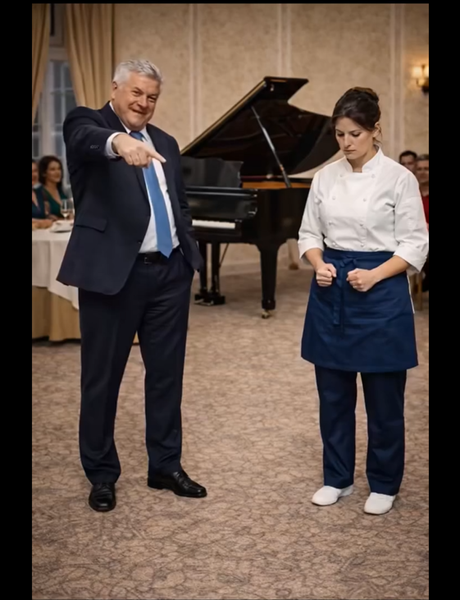
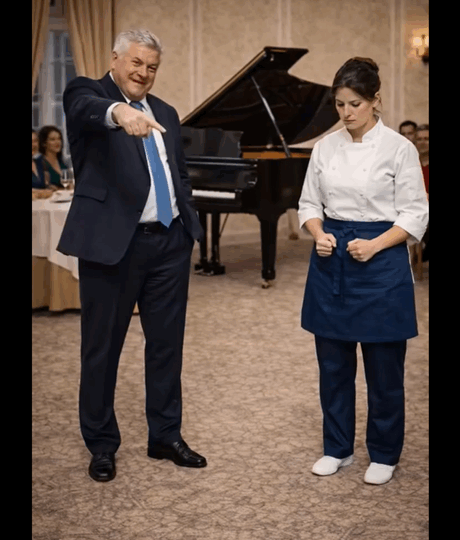
Mark’s lips curled into a smirk that never reached his eyes. He didn’t loosen his grip. Instead, he steered her forward, toward the center of the dining room, into the glare of a hundred polished eyes.
The guests, dressed in couture and glistening jewelry, fell silent as the scene unfolded. They had been expecting perfection, but they were about to witness spectacle. Mark, reveling in the drama, pressed his advantage.

“Ladies and gentlemen,” Mark announced, his voice carrying with ease to the far corners of the room. “It appears our humble cook is also a refined music critic. She finds our grand piano… lacking.”
A ripple of laughter, faintly condescending, passed through the crowd. Mark turned back to Anna, his gaze mockingly challenging. “Tell us,” he said, his tone sharp as a chef’s knife, “did you study at a conservatory? Or perhaps you’ve been practicing on the cutting boards between shifts?”
“No, sir,” Anna replied, quietly, her eyes fixed on the polished floor. “I didn’t go to a conservatory.”
Mark’s voice took on a tone of exaggerated disbelief. “What a shock,” he drawled. He waved a hand toward the corner, calling his daughter forward. “Emma, come here, darling.”
Emma emerged from the shadows, a vision of curated elegance. Her dress was worth more than Anna’s annual salary, tailored to perfection.
She moved with the poise of someone trained to command attention, her hair and makeup immaculate. Emma was Mark’s pride and joy, a pianist with accolades from the finest European masters, a living testament to his obsession with status and perfection.
Mark placed a heavy, possessive arm around her shoulders, leaning into the tableau as if it were a painting he had carefully composed.
“Here is the wager,” Mark announced. His voice was theatrically measured, carrying through the room as though each syllable were a hammer striking a bell. “Emma will play first. Then, you will play.
If you can convince this room that you are the superior musician, I will buy you a restaurant of your own. Your name will be on the sign, above the door.
But if you fail…” His eyes glinted with cruelty. “You walk out of that door right now. No pay, no references, nothing but the apron on your back.”
The audacity of it stunned her for a moment, but only a moment. Anna’s life had been a series of small humiliations, of constant underestimation.
She had learned to survive, to endure, and above all, to wait for the moment when she could speak without being interrupted.
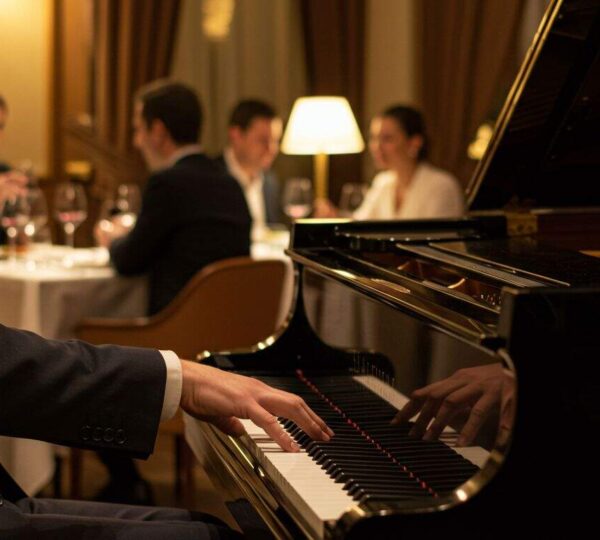
Her pulse raced—not with fear, but with a quiet, burning resolve. She looked at her hands, reddened and scarred, and then at the sleek, black Steinway before her. Without a word, she untied her apron, folded it neatly over a chair back, and waited.
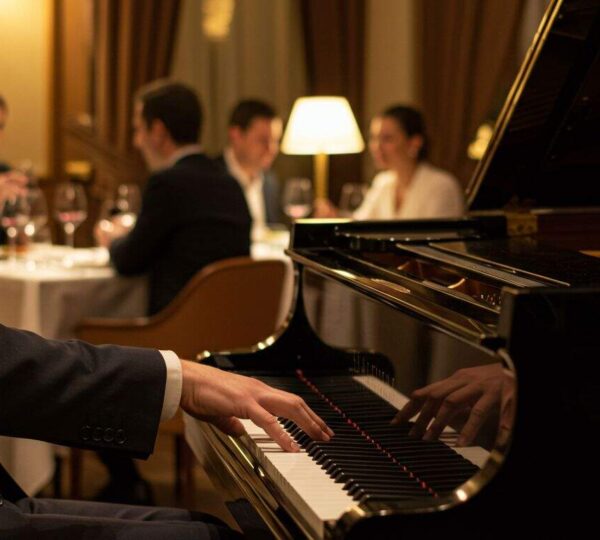
Emma took the bench first. The piece she played was technically flawless, a Liszt etude designed to impress the eye as much as the ear. Her fingers moved like machine pistons, hitting each note with immaculate timing.
The applause that followed was polite, expected, almost perfunctory. The businessmen sipped their wine, the socialites murmured compliments. Mark’s smile was wide, triumphant, the posture of a man who believed victory had been declared before the contest had truly begun.
When the applause subsided, he gestured toward the bench with a dramatic bow. “Your turn, Chef,” he said.
Anna approached the piano without hesitation. She didn’t smooth her hair or adjust her clothing. She simply sat, letting her hands rest lightly on the keys, feeling their resonance, absorbing the tension of the room.
When she began to play, it was not with a goal of virtuosity or spectacle. Instead, she allowed the music to flow from a deep, unspoken place, a river of memory and longing that had been nurtured in darkness and hardship.
Her first piece was subtle, almost hesitant at first, like a sunrise slowly brushing color across the horizon. But with each chord, her confidence grew, and so did the intensity.
The sound was unlike anything in the room. It spoke of rain on a tin roof, of long-lost love letters, of quiet nights spent alone in a kitchen too small to contain a dream.
The precision of Emma’s training was technical, but Anna’s was transcendent; it was not about hitting the right notes but about telling a story that could not be contained by measures or tempo.
he room, once filled with polite conversation, fell into silence. The guests forgot their roles, their social hierarchy, their distance from the kitchen. They listened. They felt.
When the last note faded, there was a long, almost unbearable pause. Then, as if the spell broke all at once, the room erupted into applause. But it was not the perfunctory clap of etiquette—it was genuine, heartfelt, irrepressible.
Feet rose from the floor, hands clapped with fervor, some guests even wiped tears from their eyes. Mark’s face, previously a mask of smug assurance, twisted into confusion and disbelief.
He shook his head, voice cracking as he spoke. “That… that’s just one song. You probably spent years learning only that. Play something else. Something difficult.”
Anna nodded. She did not reach for sheet music. Instead, she let her fingers find the keys as though they were extensions of her own body. She played a Chopin ballade of formidable complexity, a work that demanded precision, intuition, and emotion. Each note was delivered with grace, each pause pregnant with tension.
The audience leaned forward as though fearing to break the spell. Even the most seasoned critics in the room were held hostage by the purity of her performance. When the final note lingered and dissolved into silence, it felt as though the world had been briefly suspended in midair.
Mark looked at her as though she were a ghost, a phantom conjured from the ether to shame him with talent he could neither buy nor command. He whispered, almost to himself, “Where… where did a line cook learn to play like that?”
Anna stood. Her posture was steady, her voice calm, carrying the weight of experience without arrogance. “My grandmother was a concert pianist before the war,” she said. “She lost everything, including her stage, but she never lost her music. She taught me in the dark, on a piano missing half its ivory.
She taught me that music isn’t about the dress you wear, the academy you attend, or the applause you receive. It’s about what you have to say when the world stops listening.”
Silence followed. Mark turned to his daughter, who remained in the shadows, her head bowed in acknowledgment of a talent she could never emulate.
The guests’ faces were still wet with emotion, and for a moment, the room seemed suspended between past and present, between expectation and revelation.
Finally, Mark met Anna’s eyes. He exhaled, slow and heavy. He was a man of many flaws, but he was also a man of his word. To deny her now would be to admit his own irrelevance.
“I will keep my word,” he said, voice regaining strength. “The restaurant is yours.”
Anna nodded. She didn’t celebrate. She picked up her folded apron, the symbol of years of unseen labor, and returned to the kitchen.
She had always been underestimated, yet she had proven that greatness was not inherited or purchased—it was expressed. The restaurant bore her name now, but the music had always been hers.
And in that moment, she understood that her voice, when finally heard, could alter the course of even the most rigid hierarchy.
The evening faded into memory. Patrons spoke of the incident for weeks, of the chef who could move hearts as easily as she could plate a scallop.
Emma never regained the same air of invincibility, and Mark, quietly humbled, began to see the value of skill, perseverance, and heart over pedigree and performance. Anna continued to cook, to play, and to live in a world that had underestimated her—but now, she moved through it on her own terms, a quiet force of undeniable brilliance.
