...

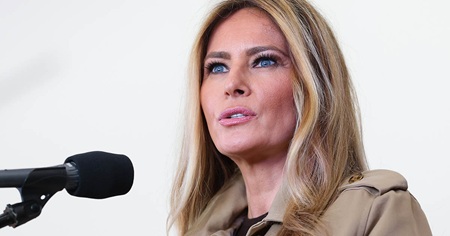
Melania Trump delivers a chilling warning before an audience of military families.

The first official joint appearance of First Lady Melania Trump and Second Lady Usha Vance on Wednesday was more than a ceremonial visit — it was a moment layered with symbolism, emotion, and a rare glimpse into the future vision of America’s leadership. Their destination was Camp Lejeune, the largest Marine Corps base on the East Coast and a place that represents duty, sacrifice, and resilience for tens of thousands of American families.

From the moment the First Lady’s motorcade arrived at the base, excitement filled the air. Children from military families stood with handmade signs, teachers lined the entrance of Lejeune High School, and local media captured the moment with anticipation. For many families, especially those whose spouses are deployed, the visit felt like a reminder that their sacrifices are seen at the highest levels of leadership.

But as the day unfolded, what began as a visit rooted in gratitude and encouragement evolved into something far deeper. It ended with a sobering national message — one that Melania Trump delivered with unusual directness: the urgent and potentially dangerous rise of artificial intelligence in modern warfare. That single message transformed the day’s visit into something historic.
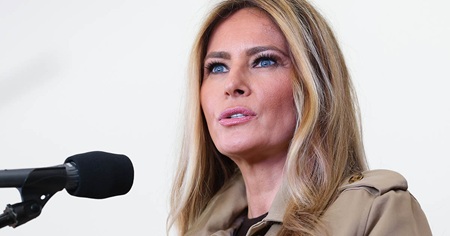
A Warm Arrival at Camp Lejeune

Melania Trump and Usha Vance arrived together, their appearance marking the start of what many believe will be a collaborative and active role supporting military families. Both women were greeted with applause as they entered Lejeune High School, where the halls had been decorated in their honor. Students had placed posters on the walls, thanking them for their service and support.

Teachers later said they had never seen the students so excited for a guest visit. The First Lady spoke with children, shook hands, and paused for several photos with families — a gesture that left many visibly touched. Several spouses mentioned how meaningful it felt to have national leaders visit during the holidays, a time when many military families feel the absence of loved ones most intensely.

Usha Vance, known for her thoughtful and grounded approach, spent time listening to parents and educators. She discussed the challenges military children face — frequent relocations, sudden goodbyes, and constantly adjusting to new schools. Her role as Second Lady, combined with her background as a mother of young children, made her presence especially relatable to the families she met.
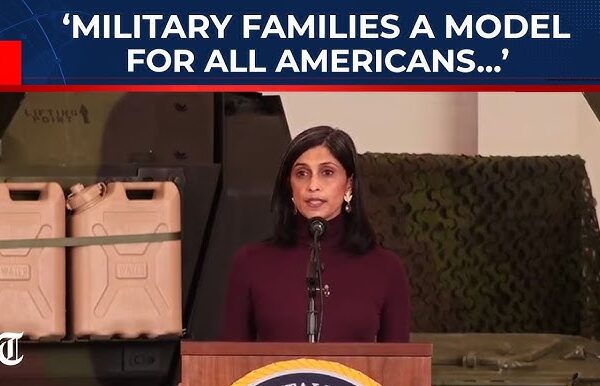
The Visit Begins Smoothly — Until a Technical Glitch Interrupts the Speech

The highlight of the morning was Melania Trump’s scheduled address to Marines and their families inside the school gymnasium. The air buzzed with energy as everyone waited for her remarks.

But just seconds after Melania began speaking, a sharp burst of microphone feedback echoed through the gym. The sound caused several children to cover their ears, and for a moment the room fell silent and tense. Melania paused with a calm smile, signaling to staff that she would wait while the microphone was fixed.

It took nearly a minute for the issue to be resolved. But the moment served as a reminder that even carefully planned events can encounter unexpected disruptions. Once the microphone stabilized, Melania resumed her speech with warmth and appreciation.

“I want to thank all of you,” she said gently. “You are the families who stand behind our nation’s defense. Your loyalty, your strength, and your sacrifices are the backbone of our security.” Her voice echoed through the gymnasium with clarity and emotion.
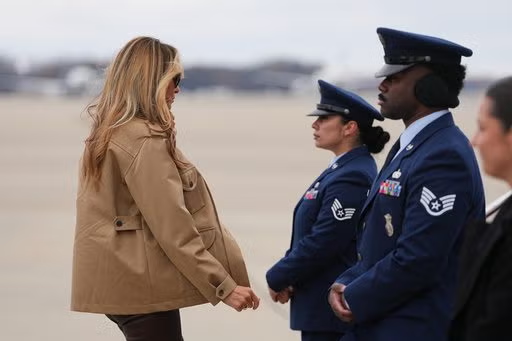
“My husband, the President, sends his best regards. We think of you every day — but we hold you especially close during the holidays.”

The applause that followed was long and genuine. Several service members later said that those simple words meant more than anyone realized. For many Marines, especially those recently returned from deployment, hearing acknowledgment from the First Lady offered a sense of national solidarity often missing in their daily routines.

A Day Focused on Education, Innovation, and the Future of Technology

After the speech, Melania and Usha turned their attention to a subject that has sparked global debate: artificial intelligence. Their visit included a roundtable conversation with high school students studying advanced technology. Teachers introduced ongoing projects where students used AI for coding exercises, digital design, and problem-solving simulations.

Melania’s interest in AI is not new. In September, she led a meeting for the White House Task Force on Artificial Intelligence Education — an initiative tied to her ongoing Be Best campaign. At that meeting, she discussed how AI will shape children’s futures and why students must be prepared not only academically, but also ethically and emotionally.

But at Camp Lejeune, Melania shifted the tone. What she shared next was not merely educational or inspirational. It was strategic. And it carried the weight of national security.

Melania Trump’s Warning: “AI Will Alter War More Profoundly Than Any Technology Since Nuclear Weapons”

Standing before students, educators, and Marines, Melania delivered a statement that caught many off guard. “Artificial Intelligence will alter war more profoundly than any technology since nuclear weapons,” she declared.

The gym fell silent — not out of fear, but out of respect for the gravity of her words. Melania explained that warfare is entering a new era where speed, automation, and advanced systems will dominate the battlefield. Decisions that once took hours could soon be made in seconds by AI-driven platforms.
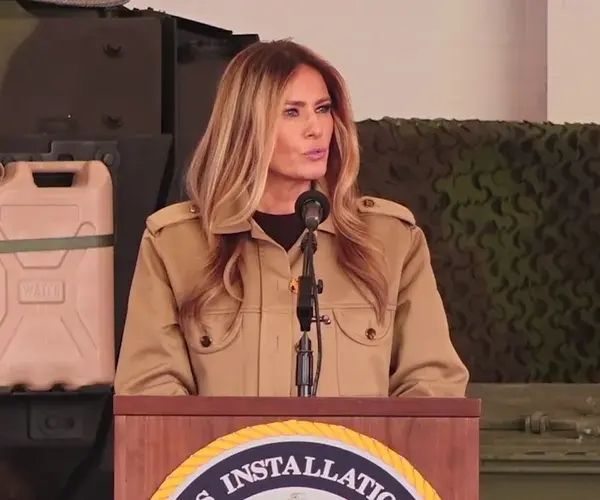
“Speed will determine the outcome of future conflicts,” she said. “As systems become more automated, Artificial Intelligence will take center stage in the theater of war.”

Her message was clear: the U.S. must prepare. Students must prepare. And the next generation must understand that technological innovation is no longer a distant possibility — it is a rapidly approaching reality.

For the first time in her public role, Melania spoke bluntly about military strategy, global threats, and the importance of innovation in shaping the nation’s security landscape.

Why Melania’s Message Resonated With Military Families

Military families are uniquely connected to global changes. When new technologies reshape warfare, they feel the impact directly — through deployments, training, and the emotional strain of uncertainty.

Melania’s comments struck a chord because:

  • Many Marines at Camp Lejeune specialize in tech-based roles.

  • Families understand that new threats may affect future missions.

  • Students at the base often pursue STEM studies because of their military environment.

By addressing AI not as a distant concept but as a pressing national focus, Melania acknowledged a reality these families have lived with for years: the world is changing fast, and the U.S. must change with it.

A Symbol of Unity Between the First Lady and Second Lady

The partnership between Melania Trump and Usha Vance also carries symbolic meaning. Their first joint appearance reflects a coordinated effort to strengthen family-focused initiatives, support military communities, and highlight emerging national challenges.

Observers noted that the two women interacted with ease throughout the day — talking, listening, and sharing responsibilities during the event. Their collaboration is expected to grow during the coming months as the administration places greater emphasis on education, family health, and technological advancement.

A Visit That Expanded Into a National Conversation

Although the event began as a routine visit, Melania’s warning transformed it into a moment of national relevance. Her comments reached far beyond the walls of the school gymnasium, raising critical questions:

  • How will AI change the battlefield of the future?

  • What must America do to stay competitive and secure?

  • How can schools prepare the next generation for technological realities that are rapidly approaching?

  • What ethical issues will arise as AI becomes more involved in military systems?

These are not questions for political leaders alone. They are questions for educators, parents, military families, and citizens across the nation.

Melania Trump’s visit to Camp Lejeune may have lasted only a day, but the impact of her message continues to ripple through military families, educational circles, and national security experts. What began as a supportive visit for service members evolved into one of the most direct public warnings from a First Lady about the future of warfare, technology, and the responsibility of the next generation.

This second part expands deeply on the broader implications, the shifting global landscape, the reactions inside the base, and why Melania’s message may mark a turning point in how Americans understand the future of national defense.

The Emotional Pulse Inside Camp Lejeune After Melania’s Warning

After Melania concluded her remarks, the atmosphere inside the school changed noticeably. Conversations shifted from excitement about the First Lady’s presence to curiosity — and in some cases concern — about the implications of her message.

Several Marines expressed appreciation for her honesty. For them, the idea that AI is reshaping warfare is not abstract — it is something they witness in training, strategy updates, and evolving mission requirements. One Marine, whose name was withheld for privacy, told reporters:

“Most speeches we hear are about support and gratitude — which we appreciate. But this felt different. It felt like she was preparing the nation for something bigger that’s coming.” Parents attending the event also reacted with a mix of seriousness and reflection. Many acknowledged that their children, who often grow up surrounded by military culture, are already more aware of global dynamics than the average student.

One mother, holding her toddler in her arms, said: “It was a wake-up call. Our kids need to understand technology not just as something fun, but as something that can shape the world they inherit.”

This emotional undercurrent turned the gymnasium from a place of celebration into a space of deeper understanding. People walked away feeling that the First Lady’s message was not designed to alarm — but to prepare.

How AI Is Already Changing the Military — And Why Melania’s Message Was Urgent

While Melania’s remarks were directed at the future, many analysts have pointed out that artificial intelligence is already woven into modern defense systems. Her comments reflected a growing national—and global—concern.

1. Decision-Making At Unprecedented Speed

AI can process battlefield data faster than human commanders, identifying threats in seconds rather than minutes. That speed can determine the outcome of conflicts.

2. Automated Defense Systems

Countries around the world are developing autonomous drones, cyber-defense systems, and automated surveillance tools. These technologies raise difficult ethical questions:

  • Who is responsible for decisions made by autonomous systems?

  • How do we prevent errors that could trigger unintended escalation?

3. Cybersecurity Threats

AI can be used to strengthen cyber defenses — but it can also be used to break them. Melania’s warning highlighted the importance of preparing future generations for this rapidly shifting environment.

4. Global Competition

Nations such as China, Russia, and major European powers are investing heavily in AI-based military technologies. Melania’s statement was a reminder that America must remain competitive to maintain global stability. Her speech was not political. It was strategic — and delivered from a position of concern for American families.

The Educational Impact: Why Melania Focused on Students

Melania Trump’s choice to deliver this message at a high school — not a Pentagon briefing — was intentional. She aimed it at the generation who will become:

  • engineers

  • military analysts

  • cybersecurity specialists

  • robotics developers

  • policymakers

  • innovators

Her message was clear: students must be prepared not only academically, but ethically and strategically.

The First Lady has repeatedly emphasized that children are at the center of national progress. Her Be Best initiative often highlights digital responsibility, online safety, and emotional development. This visit expanded that mission into the realm of emerging technology and global security.

Many teachers at Lejeune High School said the visit encouraged students to approach technology with more seriousness and curiosity. Some students even spoke openly about pursuing careers in AI, robotics, and cyber-defense after hearing Melania speak.

Inside the Private Meeting: Melania and Usha’s Quiet Conversation With Military Spouses

In addition to the public events, Melania and Usha held a private roundtable with several military spouses. According to sources present, the discussion covered topics such as:

  • emotional challenges of deployment

  • access to mental-health support

  • the pressure placed on military children

  • the fast-changing world of technology

  • support systems needed for families facing relocation

During this meeting, Melania reportedly expanded on her earlier remarks, explaining that AI isn’t simply a military issue — it will reshape civilian life, jobs, education, and even family security.

One spouse later said:

“She wasn’t trying to scare us. She was trying to prepare us. That meant a lot.”

This personal approach is often part of Melania’s public presence — quiet, understated, but deeply focused on family strength and national unity.

National Reactions: Analysts Call the Speech ‘Unexpected but Necessary’

After news of Melania’s remarks spread nationwide, technology experts, defense analysts, and policy scholars reacted widely.

1. Defense Analysts

Many praised her for highlighting a topic often confined to military briefings.

“The First Lady brought the reality of AI warfare to mainstream conversation,” one analyst remarked.
“That is significant and overdue.”

2. AI Researchers

Some researchers agreed with Melania’s framing, noting that AI systems have already surpassed human limitations in certain strategic tasks.

3. Ethical and Human-Rights Experts

These specialists emphasized the need for global standards and ethical guidelines as AI becomes more involved in defense operations.

4. Political Observers

Analysts across the political spectrum noted that Melania’s speech avoided partisanship and focused on national unity — a tone that resonated widely.

Why This Visit May Be Remembered as a Turning Point

Several factors make this moment particularly meaningful:

1. The First and Second Ladies United on a Strategic Issue

The joint appearance of Melania Trump and Usha Vance symbolized a shared commitment to future-focused challenges. Their unity sends a message that education, technology, and security are bipartisan concerns.

2. AI Is No Longer a Distant Threat

Melania’s speech placed the issue directly in front of families. It made AI a topic of everyday conversation, not just expert debate.

3. The Setting — A Military Base Rich With Family History

Camp Lejeune is a place filled with stories of sacrifice. Delivering such a serious message in this environment amplifies its meaning.

4. The Audience — Students Who Will Inherit Tomorrow’s Challenges

Speaking to children transformed the message from a strategic briefing into a call for national readiness.

A Growing National Conversation: How Should America Prepare?

As the speech circulates, Americans are asking critical questions:

  • Should AI education become a core part of school curricula?

  • How do we protect jobs as automation expands?

  • What global rules should govern AI in warfare?

  • How can we ensure AI aligns with human ethics and national values?

  • What steps must families take to prepare their children for a world shaped by technology?

The speech has done more than raise awareness — it has sparked debate across homes, schools, communities, and national institutions.

A Message Rooted in Protection, Not Fear

While some may interpret Melania’s remarks as alarming, those close to the First Lady say the intent was protective. Her message carried the same foundational tone that has defined her public service:

  • safeguard children

  • strengthen families

  • build awareness

  • promote responsibility

  • ensure national unity

She spoke not as a military strategist, but as a mother, a national representative, and a guardian of future generations.

The Legacy of the Camp Lejeune Visit

As the day ended, Melania and Usha departed Camp Lejeune with warm farewells. Families waved, students clapped, and Marines stood in rows saluting the motorcade as it left the base.

Even after the vehicles disappeared, people continued discussing Melania’s message — some in quiet circles, others in animated conversations. The visit left a mark on the base and its families, not because of a ceremonial speech, but because of the depth and seriousness of the message delivered.

It reminded Americans that the future is approaching quickly — and that preparation, unity, and knowledge are the tools that will guide the next generation.

Final Thoughts

Melania Trump’s warning about AI may be remembered as one of the most important messages delivered during her role as First Lady. It was not political. It was not dramatic. It was a call to awareness — a reminder that America’s greatest strength lies in its families, its students, its innovators, and its commitment to facing the future with courage and clarity.

Her visit to Camp Lejeune was more than an event. It was a starting point — a moment that will likely continue shaping conversations about technology, national security, and the responsibility we all share in preparing for the world ahead.

The first official joint appearance of First Lady Melania Trump and Second Lady Usha Vance on Wednesday was more than a ceremonial visit — it was a moment layered with symbolism, emotion, and a rare glimpse into the future vision of America’s leadership. Their destination was Camp Lejeune, the largest Marine Corps base on the East Coast and a place that represents duty, sacrifice, and resilience for tens of thousands of American families.

From the moment the First Lady’s motorcade arrived at the base, excitement filled the air. Children from military families stood with handmade signs, teachers lined the entrance of Lejeune High School, and local media captured the moment with anticipation. For many families, especially those whose spouses are deployed, the visit felt like a reminder that their sacrifices are seen at the highest levels of leadership.

But as the day unfolded, what began as a visit rooted in gratitude and encouragement evolved into something far deeper. It ended with a sobering national message — one that Melania Trump delivered with unusual directness: the urgent and potentially dangerous rise of artificial intelligence in modern warfare. That single message transformed the day’s visit into something historic.

A Warm Arrival at Camp Lejeune

Melania Trump and Usha Vance arrived together, their appearance marking the start of what many believe will be a collaborative and active role supporting military families. Both women were greeted with applause as they entered Lejeune High School, where the halls had been decorated in their honor. Students had placed posters on the walls, thanking them for their service and support.

Teachers later said they had never seen the students so excited for a guest visit. The First Lady spoke with children, shook hands, and paused for several photos with families — a gesture that left many visibly touched. Several spouses mentioned how meaningful it felt to have national leaders visit during the holidays, a time when many military families feel the absence of loved ones most intensely.

Usha Vance, known for her thoughtful and grounded approach, spent time listening to parents and educators. She discussed the challenges military children face — frequent relocations, sudden goodbyes, and constantly adjusting to new schools. Her role as Second Lady, combined with her background as a mother of young children, made her presence especially relatable to the families she met.

The Visit Begins Smoothly — Until a Technical Glitch Interrupts the Speech

The highlight of the morning was Melania Trump’s scheduled address to Marines and their families inside the school gymnasium. The air buzzed with energy as everyone waited for her remarks.

But just seconds after Melania began speaking, a sharp burst of microphone feedback echoed through the gym. The sound caused several children to cover their ears, and for a moment the room fell silent and tense. Melania paused with a calm smile, signaling to staff that she would wait while the microphone was fixed.

It took nearly a minute for the issue to be resolved. But the moment served as a reminder that even carefully planned events can encounter unexpected disruptions. Once the microphone stabilized, Melania resumed her speech with warmth and appreciation.

“I want to thank all of you,” she said gently. “You are the families who stand behind our nation’s defense. Your loyalty, your strength, and your sacrifices are the backbone of our security.” Her voice echoed through the gymnasium with clarity and emotion.

“My husband, the President, sends his best regards. We think of you every day — but we hold you especially close during the holidays.”

The applause that followed was long and genuine. Several service members later said that those simple words meant more than anyone realized. For many Marines, especially those recently returned from deployment, hearing acknowledgment from the First Lady offered a sense of national solidarity often missing in their daily routines.

A Day Focused on Education, Innovation, and the Future of Technology

After the speech, Melania and Usha turned their attention to a subject that has sparked global debate: artificial intelligence. Their visit included a roundtable conversation with high school students studying advanced technology. Teachers introduced ongoing projects where students used AI for coding exercises, digital design, and problem-solving simulations.

Melania’s interest in AI is not new. In September, she led a meeting for the White House Task Force on Artificial Intelligence Education — an initiative tied to her ongoing Be Best campaign. At that meeting, she discussed how AI will shape children’s futures and why students must be prepared not only academically, but also ethically and emotionally.

But at Camp Lejeune, Melania shifted the tone. What she shared next was not merely educational or inspirational. It was strategic. And it carried the weight of national security.

Melania Trump’s Warning: “AI Will Alter War More Profoundly Than Any Technology Since Nuclear Weapons”

Standing before students, educators, and Marines, Melania delivered a statement that caught many off guard. “Artificial Intelligence will alter war more profoundly than any technology since nuclear weapons,” she declared.

The gym fell silent — not out of fear, but out of respect for the gravity of her words. Melania explained that warfare is entering a new era where speed, automation, and advanced systems will dominate the battlefield. Decisions that once took hours could soon be made in seconds by AI-driven platforms.

“Speed will determine the outcome of future conflicts,” she said. “As systems become more automated, Artificial Intelligence will take center stage in the theater of war.”

Her message was clear: the U.S. must prepare. Students must prepare. And the next generation must understand that technological innovation is no longer a distant possibility — it is a rapidly approaching reality.

For the first time in her public role, Melania spoke bluntly about military strategy, global threats, and the importance of innovation in shaping the nation’s security landscape.

Why Melania’s Message Resonated With Military Families

Military families are uniquely connected to global changes. When new technologies reshape warfare, they feel the impact directly — through deployments, training, and the emotional strain of uncertainty.

Melania’s comments struck a chord because:

  • Many Marines at Camp Lejeune specialize in tech-based roles.

  • Families understand that new threats may affect future missions.

  • Students at the base often pursue STEM studies because of their military environment.

By addressing AI not as a distant concept but as a pressing national focus, Melania acknowledged a reality these families have lived with for years: the world is changing fast, and the U.S. must change with it.

A Symbol of Unity Between the First Lady and Second Lady

The partnership between Melania Trump and Usha Vance also carries symbolic meaning. Their first joint appearance reflects a coordinated effort to strengthen family-focused initiatives, support military communities, and highlight emerging national challenges.

Observers noted that the two women interacted with ease throughout the day — talking, listening, and sharing responsibilities during the event. Their collaboration is expected to grow during the coming months as the administration places greater emphasis on education, family health, and technological advancement.

A Visit That Expanded Into a National Conversation

Although the event began as a routine visit, Melania’s warning transformed it into a moment of national relevance. Her comments reached far beyond the walls of the school gymnasium, raising critical questions:

  • How will AI change the battlefield of the future?

  • What must America do to stay competitive and secure?

  • How can schools prepare the next generation for technological realities that are rapidly approaching?

  • What ethical issues will arise as AI becomes more involved in military systems?

These are not questions for political leaders alone. They are questions for educators, parents, military families, and citizens across the nation.

Melania Trump’s visit to Camp Lejeune may have lasted only a day, but the impact of her message continues to ripple through military families, educational circles, and national security experts. What began as a supportive visit for service members evolved into one of the most direct public warnings from a First Lady about the future of warfare, technology, and the responsibility of the next generation.

This second part expands deeply on the broader implications, the shifting global landscape, the reactions inside the base, and why Melania’s message may mark a turning point in how Americans understand the future of national defense.

The Emotional Pulse Inside Camp Lejeune After Melania’s Warning

After Melania concluded her remarks, the atmosphere inside the school changed noticeably. Conversations shifted from excitement about the First Lady’s presence to curiosity — and in some cases concern — about the implications of her message.

Several Marines expressed appreciation for her honesty. For them, the idea that AI is reshaping warfare is not abstract — it is something they witness in training, strategy updates, and evolving mission requirements. One Marine, whose name was withheld for privacy, told reporters:

“Most speeches we hear are about support and gratitude — which we appreciate. But this felt different. It felt like she was preparing the nation for something bigger that’s coming.” Parents attending the event also reacted with a mix of seriousness and reflection. Many acknowledged that their children, who often grow up surrounded by military culture, are already more aware of global dynamics than the average student.

One mother, holding her toddler in her arms, said: “It was a wake-up call. Our kids need to understand technology not just as something fun, but as something that can shape the world they inherit.”

This emotional undercurrent turned the gymnasium from a place of celebration into a space of deeper understanding. People walked away feeling that the First Lady’s message was not designed to alarm — but to prepare.

How AI Is Already Changing the Military — And Why Melania’s Message Was Urgent

While Melania’s remarks were directed at the future, many analysts have pointed out that artificial intelligence is already woven into modern defense systems. Her comments reflected a growing national—and global—concern.

1. Decision-Making At Unprecedented Speed

AI can process battlefield data faster than human commanders, identifying threats in seconds rather than minutes. That speed can determine the outcome of conflicts.

2. Automated Defense Systems

Countries around the world are developing autonomous drones, cyber-defense systems, and automated surveillance tools. These technologies raise difficult ethical questions:

  • Who is responsible for decisions made by autonomous systems?

  • How do we prevent errors that could trigger unintended escalation?

3. Cybersecurity Threats

AI can be used to strengthen cyber defenses — but it can also be used to break them. Melania’s warning highlighted the importance of preparing future generations for this rapidly shifting environment.

4. Global Competition

Nations such as China, Russia, and major European powers are investing heavily in AI-based military technologies. Melania’s statement was a reminder that America must remain competitive to maintain global stability. Her speech was not political. It was strategic — and delivered from a position of concern for American families.

The Educational Impact: Why Melania Focused on Students

Melania Trump’s choice to deliver this message at a high school — not a Pentagon briefing — was intentional. She aimed it at the generation who will become:

  • engineers

  • military analysts

  • cybersecurity specialists

  • robotics developers

  • policymakers

  • innovators

Her message was clear: students must be prepared not only academically, but ethically and strategically.

The First Lady has repeatedly emphasized that children are at the center of national progress. Her Be Best initiative often highlights digital responsibility, online safety, and emotional development. This visit expanded that mission into the realm of emerging technology and global security.

Many teachers at Lejeune High School said the visit encouraged students to approach technology with more seriousness and curiosity. Some students even spoke openly about pursuing careers in AI, robotics, and cyber-defense after hearing Melania speak.

Inside the Private Meeting: Melania and Usha’s Quiet Conversation With Military Spouses

In addition to the public events, Melania and Usha held a private roundtable with several military spouses. According to sources present, the discussion covered topics such as:

  • emotional challenges of deployment

  • access to mental-health support

  • the pressure placed on military children

  • the fast-changing world of technology

  • support systems needed for families facing relocation

During this meeting, Melania reportedly expanded on her earlier remarks, explaining that AI isn’t simply a military issue — it will reshape civilian life, jobs, education, and even family security.

One spouse later said:

“She wasn’t trying to scare us. She was trying to prepare us. That meant a lot.”

This personal approach is often part of Melania’s public presence — quiet, understated, but deeply focused on family strength and national unity.

National Reactions: Analysts Call the Speech ‘Unexpected but Necessary’

After news of Melania’s remarks spread nationwide, technology experts, defense analysts, and policy scholars reacted widely.

1. Defense Analysts

Many praised her for highlighting a topic often confined to military briefings.

“The First Lady brought the reality of AI warfare to mainstream conversation,” one analyst remarked.
“That is significant and overdue.”

2. AI Researchers

Some researchers agreed with Melania’s framing, noting that AI systems have already surpassed human limitations in certain strategic tasks.

3. Ethical and Human-Rights Experts

These specialists emphasized the need for global standards and ethical guidelines as AI becomes more involved in defense operations.

4. Political Observers

Analysts across the political spectrum noted that Melania’s speech avoided partisanship and focused on national unity — a tone that resonated widely.

Why This Visit May Be Remembered as a Turning Point

Several factors make this moment particularly meaningful:

1. The First and Second Ladies United on a Strategic Issue

The joint appearance of Melania Trump and Usha Vance symbolized a shared commitment to future-focused challenges. Their unity sends a message that education, technology, and security are bipartisan concerns.

2. AI Is No Longer a Distant Threat

Melania’s speech placed the issue directly in front of families. It made AI a topic of everyday conversation, not just expert debate.

3. The Setting — A Military Base Rich With Family History

Camp Lejeune is a place filled with stories of sacrifice. Delivering such a serious message in this environment amplifies its meaning.

4. The Audience — Students Who Will Inherit Tomorrow’s Challenges

Speaking to children transformed the message from a strategic briefing into a call for national readiness.

A Growing National Conversation: How Should America Prepare?

As the speech circulates, Americans are asking critical questions:

  • Should AI education become a core part of school curricula?

  • How do we protect jobs as automation expands?

  • What global rules should govern AI in warfare?

  • How can we ensure AI aligns with human ethics and national values?

  • What steps must families take to prepare their children for a world shaped by technology?

The speech has done more than raise awareness — it has sparked debate across homes, schools, communities, and national institutions.

A Message Rooted in Protection, Not Fear

While some may interpret Melania’s remarks as alarming, those close to the First Lady say the intent was protective. Her message carried the same foundational tone that has defined her public service:

  • safeguard children

  • strengthen families

  • build awareness

  • promote responsibility

  • ensure national unity

She spoke not as a military strategist, but as a mother, a national representative, and a guardian of future generations.

The Legacy of the Camp Lejeune Visit

As the day ended, Melania and Usha departed Camp Lejeune with warm farewells. Families waved, students clapped, and Marines stood in rows saluting the motorcade as it left the base.

Even after the vehicles disappeared, people continued discussing Melania’s message — some in quiet circles, others in animated conversations. The visit left a mark on the base and its families, not because of a ceremonial speech, but because of the depth and seriousness of the message delivered.

It reminded Americans that the future is approaching quickly — and that preparation, unity, and knowledge are the tools that will guide the next generation.

Final Thoughts

Melania Trump’s warning about AI may be remembered as one of the most important messages delivered during her role as First Lady. It was not political. It was not dramatic. It was a call to awareness — a reminder that America’s greatest strength lies in its families, its students, its innovators, and its commitment to facing the future with courage and clarity.

Her visit to Camp Lejeune was more than an event. It was a starting point — a moment that will likely continue shaping conversations about technology, national security, and the responsibility we all share in preparing for the world ahead.