
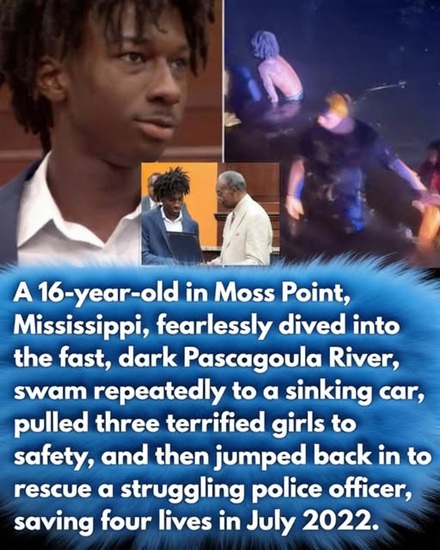
On a warm July night in Pascagoula, Mississippi, what began as an ordinary evening for several teenagers quickly became an event that would change lives forever — marked by danger, fear, swift decision‑making, and ultimately, extraordinary courage.
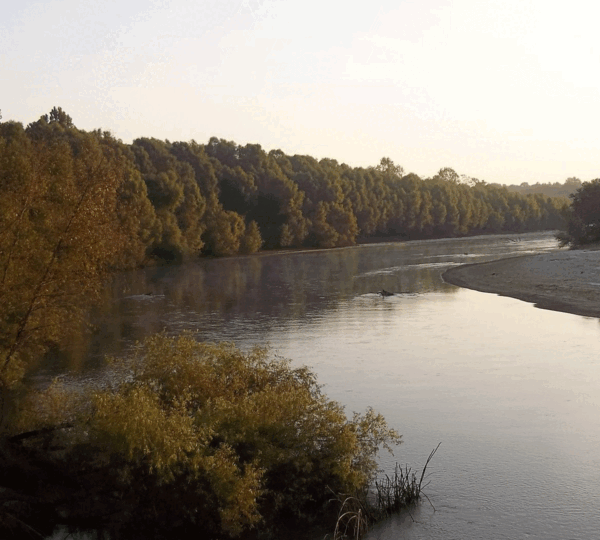
The setting was the Pascagoula River, a wide, powerful waterway that carves its way through the Gulf Coast region, near a quiet area of the city used for boating and fishing.
It was late — around 2:30 a.m. — when a vehicle carrying three teenage girls unexpectedly barreled off a boat launch and into the river, instantly turning a peaceful night into a desperate struggle for survival.
In just minutes, a 16‑year‑old high school student standing nearby — Corion Evans — would show a level of self‑less bravery most adults could scarcely imagine. His quick thinking and fearless actions ultimately saved four lives amid powerful currents and near‑certain peril.
A Misguided Drive That Almost Became Tragic
According to authorities, the vehicle carrying the three teenage girls was driving off an I‑10 boat ramp in Moss Point — a roadway where land meets water directly.
The driver later told police she had been following her GPS and did not realize she was heading down the unlit ramp into the Pascagoula River. The lack of clear visual cues in the darkness contributed to the mistake, with the GPS indicating a continuation of road ahead where there was only water.
The car floated approximately 20 feet from shore before beginning to sink, landing in deep, moving water where strong currents are common and water temperatures can sap strength from even experienced swimmers.
The three girls managed to escape the sinking vehicle and cling to its roof, far from the riverbank, shouting for help that seemed distant in the quiet night. In an instant, they were in a life‑and‑death situation — pinned between cold, swirling water and fading hope.
The Moment of Truth: Corion Evans Acts Without Hesitation
At that moment, Corion Evans, a rising senior at Pascagoula High School, spotted the unfolding crisis. He later told local news that he immediately heard the girls’ voices and saw the sinking vehicle.
Without hesitating, he kicked off his shoes, removed his shirt, left his phone on shore, and ran into the river, instinctively launching himself into the dangerous water.
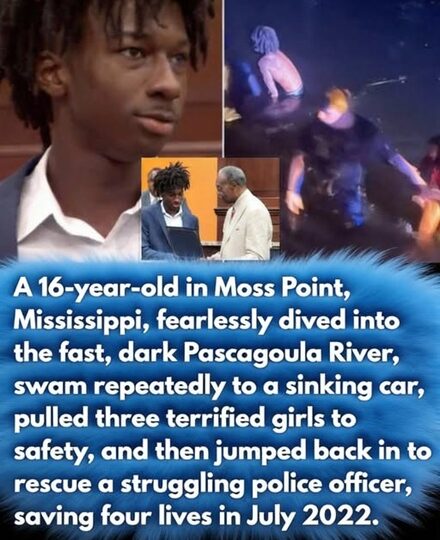
Evans was not an unfamiliar face to the water. According to his own account, he had been swimming since he was about three years old, giving him a familiarity with strong currents and aquatic conditions uncommon among many people his age.
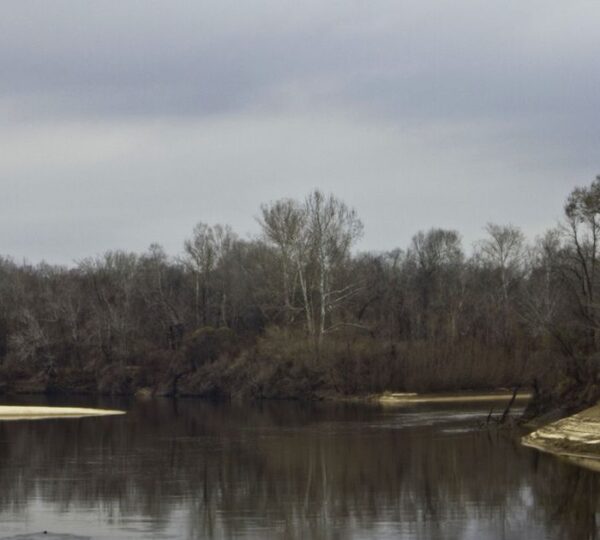
Even so, the Pascagoula is not a calm pool. Under the moonlight, the surface rippled with invisible strength, and every yard of progress toward the stranded girls required effort against a pull that could drag swimmers under. Yet Corion persisted, driven not by thought but by instinct — the simple, urgent desire to keep others alive.
Rescuing the First Victims: One by One
Reaching the girls’ position, Evans faced a complicated rescue scenario. With the car partially submerged, the most practical place for the victims to wait was on the rooftop, but it still meant they were isolated in the river’s moving current. Corion’s task was not only to get to them but help secure their safe return to shore.
Reports indicate that as Corion swam out, a friend — identified in local reporting as one of the Bradley brothers — also entered the water, assisting from behind by helping keep the girls above water and aiding in their movement toward shore.
Working together, Corion and his friend helped each girl, one by one, from the water to the riverbank, often swimming as far back as they could before nearly exhausting themselves.
The effort took both physical and emotional strength, as Corion juggled keeping the girls calm and guiding them toward safety in powerful, unforgiving water.
One of the passengers later told local outlets that Evans literally saved her life “right before my last breath,” a stark testament to just how close the situation had been to a tragedy.
A Turning Point: Saving the Rescuer
Just as it seemed the worst was over, the situation became even more dangerous.
A local police officer — identified as Officer Garry Mercer — responded to the scene and entered the river to assist the victims. In the chaos, one of the girls began panicking while the officer was attempting to bring her to shore, causing him to lose his footing, swallow water, and begin to struggle under the current’s force.
That’s when Corion heard the call for help — not from those originally in danger, but from someone intended to protect them.
Without a second thought, Corion turned and swam back out into the deep water — physically exhausted but focused — and reached Officer Mercer.
Pulling the struggling rescuer in the same way he had helped the other victims, Corion swam him toward safety until he could finally reach ground where his feet touched the riverbed.
Final Moments in the Water and Aftermath
Towards the end of the ordeal, Corion and the others had made multiple trips across the river — each a risk that could have cost them their own lives.
Yet because of his calm decisiveness, lack of hesitation, and remarkable stamina, all four people — the three teenage girls and Officer Mercer — were brought safely to shore.
Once on land, the victims were examined and treated at a local hospital for water inhalation and exhaustion. Thanks to emergency care and the efforts of first responders, all four were reported to be recovering well.
Corion himself also felt the effects of the night’s events. The vigorous swimming against current and repeated trips took a toll on his strength and energy, but he remained composed — even as he realized the full magnitude of what he had just done.
Community Honors a Young Hero
In the days that followed, local leaders and officials publicly recognized Corion for his extraordinary bravery. At a city meeting, **Mayor Billy Knight and the Moss Point Board of Aldermen presented Corion and Officer Mercer with Certificates of Commendation, honoring their actions and the courage they showed in the face of grave danger.
Police Chief Brandon Ashley also praised Corion, noting that his courage and sense of responsibility were exceptional. “If Corion had not assisted, it could have possibly turned out tragically instead of all occupants being rescued safely,” the chief said in a statement acknowledging the teen’s selflessness.
Residents of Pascagoula and surrounding communities expressed admiration and support online, celebrating Corion’s bravery and hailing him as a local hero for the dramatic rescue.
Lessons in Courage, Preparedness, and Human Response
Although Corion himself has described his actions simply — saying he “couldn’t just let them die” — his choice reflects several themes with broader lessons for communities everywhere:
1. Situational Awareness Saves Lives
Corion’s attentiveness to his surroundings, even late at night when most would not expect danger, made a life‑saving difference. His readiness to spring into action underscores that moments requiring heroism often happen suddenly and without warning.
2. Swimming Skills Matter
Corion’s strength as a swimmer was critical. He trained instinctively from a young age, giving him the confidence and ability to navigate strong currents under extreme stress. Education on swimming and water safety is a lesson that can benefit people of all ages.
3. Teamwork Makes Extraordinary Outcomes Possible
While Corion is the central hero of the story, his friend’s assistance, the officer’s initial rescue effort, and the community’s medical response all played roles in the outcome. Even when fear is present, teamwork can mean the difference between life and death.
4. Courage Is Not Absence of Fear
Corion felt fear like anyone else — the fear of drowning, exhaustion, or failure — but his actions show that courage is not the absence of fear, but the choice to act despite it.
The Legacy of a Selfless Act
Years after that July night, the story of Corion Evans continues to resonate far beyond Pascagoula. His willingness to risk his own life for others serves as a powerful example of selfless service and bravery in the face of imminent danger.
His actions remind us that in moments of chaos, individuals — no matter their age — are capable of extraordinary acts of compassion and courage.
When a crisis demands heroes, sometimes the bravest among us step forward not because they are unafraid, but because they care deeply for others.
In a world often focused on fear and risk, Corion’s story remains a compelling reminder that ordinary people can do extraordinary things — saving lives, inspiring communities, and becoming symbols of hope through acts of genuine kindness and bravery.
